

You can spend hours deciding who inherits the house, who gets the family jewelry, and who will serve as executor. Then miss a few lines near the end of the document that may make probate harder than it needs to be.
The issue is a self proving will affidavit.
In many states, a properly executed will can be perfectly valid without being self-proving. But when the will eventually reaches probate, the executor may have to provide additional proof that the signing requirements were satisfied.
Quick Answer: What Is the Self-Proving Will Mistake?
A self-proving will includes the state-required acknowledgment or witness affidavit — typically notarized — that supplies probate with evidence of how the will was executed. Without it, the will may still be valid, but the executor can face an extra proof step after your death.
And about the “$5,000” in the headline: there is no universal $5,000 penalty or average fee for forgetting a self-proving affidavit. The number represents the kind of avoidable legal expense that additional probate work can create. Depending on the state and circumstances, the extra cost could be small, substantial, or nonexistent.
On This Page
- Key Takeaways Ahead
- What Is a Self-Proving Will?
- A Valid Will Is Not Necessarily a Self-Proving Will
- What Happens in Probate Without the Affidavit?
- Is There Any Reason Not to Make a Will Self-Proving?
- The R.E.A.L. Check for a Self-Proving Will
- Can You Fix a Will That Is Not Self-Proving?
- State Rules Are Not All the Same
- What Should You Check in Your Will Right Now?
- Bottom Line
- Sources
Key Takeaways Ahead
What Is a Self-Proving Will?

A self-proving will is generally a will accompanied by the acknowledgment and witness statements required by state law to establish the circumstances of its execution without starting from scratch after the testator dies.
The details vary by state, but the basic idea is straightforward:
- You sign or acknowledge the will.
- The required witnesses attest to the signing.
- The appropriate affidavit or acknowledgment is completed.
- An authorized officer — commonly a notary — completes the required certification where state law requires it.
The Uniform Probate Code provides a widely used model for making a will self-proved, but states adopt, modify, or replace that model with their own statutes.
Michael’s First Check
Turn to the signature pages of your will. If there is a separate section containing sworn statements by the testator and witnesses plus a notarial certificate, you may have a self-proving affidavit. Do not decide based on appearance alone. Your state’s required wording and execution rules control.
A Valid Will Is Not Necessarily a Self-Proving Will
This is the distinction that matters most.
Validity asks whether the document legally qualifies as a will.
Self-proving status asks whether probate already has acceptable evidence of proper execution without requiring the executor to supply that proof later.
| Issue | Self-Proving Will | Valid but Non-Self-Proving Will |
|---|---|---|
| Can it be a valid will? | Yes | Often yes |
| Execution evidence prepared in advance? | Generally yes | Not necessarily |
| Additional witness proof at probate? | Often avoided | May be required |
| Automatically avoids probate? | No | No |
| Eliminates all will contests? | No | No |
Myth: “If My Will Is Notarized, It’s Automatically Self-Proving.”
Not necessarily. A notary stamp by itself is not the same thing as satisfying your state’s self-proof statute. The acknowledgment, affidavits, witnesses, timing and required language vary by jurisdiction.
And the reverse matters too: a will is not automatically invalid simply because it is not self-proving.
That distinction was blurred in the old version of this article. The affidavit usually affects proof of execution, not whether every otherwise valid will suddenly disappears as a legal document.
What Happens in Probate Without the Affidavit?
What happens next depends heavily on state probate procedure.
A court or probate office might accept:
- an affidavit from one or more attesting witnesses;
- a deposition or other sworn statement;
- testimony from a witness;
- another form of proof permitted by state statute or court rule; or
- alternative evidence when an original witness cannot be located or is unavailable.
So the frightening version — “your witnesses absolutely must physically appear in court” — is too broad.
The real risk is subtler and more believable: your executor may have another procedural problem to solve at exactly the moment your family wants fewer problems.
What the “$5,000 Mistake” Really Means
There is no statute imposing a $5,000 charge for a missing affidavit, and I could not support the old article’s claimed universal $2,500–$7,000 “fix-it cost.” The legitimate financial risk is additional attorney time, affidavits, witness-location work, filings, hearings, delay, or contested-probate expense if additional proof becomes necessary.
Sometimes that may cost very little. In a messy estate, it can cost thousands. The headline is a warning about avoidable friction — not a guaranteed invoice.
If you’re unfamiliar with what the executor is already responsible for, my guide to how probate works puts this extra proof step in context.
Is There Any Reason Not to Make a Will Self-Proving?

For an ordinary estate plan, I would not go looking for a strategic advantage in making probate prove something later that you can document now.
But there are legitimate reasons a will might be valid without being self-proving:
- Emergency execution: Someone may need to execute a valid will when the ideal notarization process is not available. That is different from whether an oral or verbal will can be valid at all, which depends on state law and narrower exceptions.
- Older documents: A will may predate current practices or may have been drafted under a different statutory framework.
- State differences: Not every jurisdiction handles self-proof in exactly the same way.
- Execution error: The will itself may have been signed correctly while the separate affidavit was incomplete.
Michael’s Take
The point of estate planning is to move difficult decisions away from the worst possible moment. If your state gives you a straightforward way to document proper execution while everybody is alive, available and remembers the signing, that is usually a better time to collect the evidence.
The R.E.A.L. Check for a Self-Proving Will
The old article’s R.E.A.L. framework is worth keeping, but with the legal claims tightened. Use it as a review checklist — not a substitute for your state’s statute or an estate attorney.
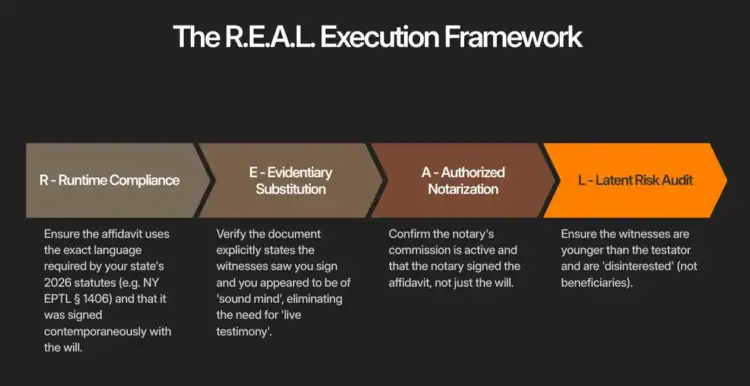
R — Rules
Does the affidavit comply with the law of the state governing your will? State statutes can specify the required acknowledgment, witness statements, notarial certificate and execution procedure.
E — Evidence
Does the affidavit establish the facts probate would otherwise need to prove, such as execution by the testator and attestation by the witnesses?
A — Authorized Officer
Was the acknowledgment or affidavit made before the person authorized under your state’s law, commonly a notary or other officer authorized to administer oaths?
L — Last-Page Audit
Do not just confirm that the will itself has signatures. Confirm that the self-proof section is complete, the required parties signed it, and the notarial certificate is complete.
Do Not “Repair” the Document Yourself
If you find a blank affidavit, missing signature or questionable notarization on an existing will, don’t fill it in later, backdate anything, or improvise a fix. Ask an estate attorney what your state permits. Altering an executed estate document can create a much larger problem than the one you were trying to solve.
Estate Plans Fail in the Small Print
The expensive mistakes are often not dramatic tax strategies. They’re an outdated beneficiary, a missing signature, an unfunded trust, or one document nobody checked after it was signed. Get practical estate-planning and retirement-rule checks translated into plain English each week.
Can You Fix a Will That Is Not Self-Proving?
Possibly — and this is another place where the original article was too absolute.
Some states expressly allow a will to be made self-proving after the original execution while the testator and witnesses are still available.
Florida is a clear example. Florida Statute § 732.503 says a will or codicil may be made self-proved at execution or at a subsequent date.
New Jersey separately recognizes self-proof at execution and later self-proof procedures, and its probate statute says a will properly acknowledged under the applicable self-proof provisions may be admitted without further affidavit, deposition or proof.
New York uses its own procedure. Under Surrogate’s Court Procedure Act § 1406, an attesting witness may make an out-of-court affidavit containing the facts that would establish genuineness, proper execution and capacity. The court can accept that affidavit as though the testimony had been taken before the court, subject to objections or the court requiring the witness.
Important Correction
The previous version told readers they would necessarily need a “self-proving codicil” if the affidavit was missing. That is too prescriptive. The right fix could be a later affidavit, re-execution, a codicil, a new will, or no change at all depending on the jurisdiction and the document. Ask what your state’s law permits before changing the estate plan.
What About the Harmless Error Doctrine?
Some states have adopted versions of the Uniform Probate Code’s harmless-error rule, which can allow a court to excuse certain defects when the required level of proof establishes the decedent’s intent.
But that is not a planning strategy.
If your family has to persuade a judge to rescue a defective document after your death, the estate plan has already moved from planning into litigation risk.
For broader examples of document problems that can create the same kind of avoidable friction, see my guide to common estate planning mistakes.
State Rules Are Not All the Same
This is where generic self-proving-affidavit templates become dangerous. The concept is similar from state to state; the implementation is not.
New Jersey
New Jersey’s N.J.S. 3B:3-4 provides a statutory procedure for a will to be simultaneously executed, attested and made self-proved through the testator’s acknowledgment and the witnesses’ affidavits before an authorized officer.
New Jersey also distinguishes ordinary proof from self-proof. Under its probate rules, a properly self-proved will can be admitted without the additional affidavit, deposition or proof otherwise needed to establish execution. See the New Jersey statutory provisions on self-proved wills.
New York
The prior article incorrectly labeled the relevant provision “NY EPTL § 1406.” The relevant statute is SCPA § 1406 — the Surrogate’s Court Procedure Act, not the Estates, Powers and Trusts Law.
New York allows attesting witnesses to provide affidavits outside court that may be accepted as their testimony unless an interested party objects or the court requires the witness to appear.
Florida
Florida Statute § 732.503 allows a qualifying will or codicil to be made self-proved at execution or at a subsequent date. The statute provides the form of acknowledgment, witness affidavits and officer certification.
Florida law also says a qualifying self-proving affidavit can establish prima facie formal execution and attestation if the will is later contested. That is meaningful evidence, but it is not the same as making the will immune from every challenge.
Do Not Download a Random “50-State” Affidavit
Search results are full of generic self-proving affidavit templates. This is exactly the kind of document where “almost right” can defeat the purpose. Verify the current statute in the state governing your will before relying on downloaded wording.
What Should You Check in Your Will Right Now?
You do not need to become a probate lawyer tonight. You do need to know which questions to ask.
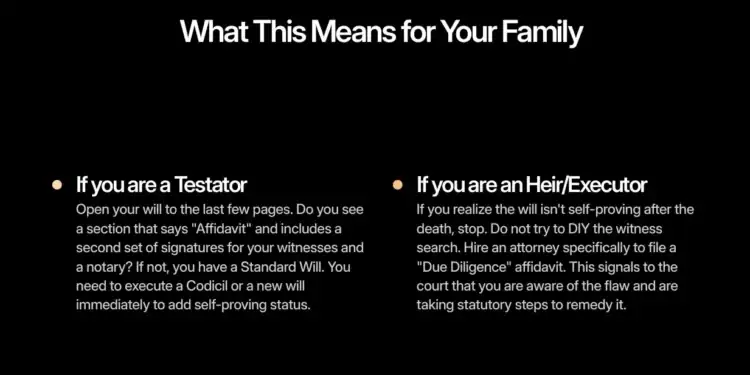
If It Is Your Will
- Find the original signed will.
- Look for a separate self-proving affidavit, witness affidavit, acknowledgment or similar section.
- Confirm that the required testator, witness and notary/officer signatures appear complete.
- Ask the attorney who prepared it: “Is this will self-proving under my state’s current law?”
- If the answer is no, ask: “Does anything need to be done now, and what is the cleanest legally permitted method?”
If You Are Already the Executor
Do not assume a missing affidavit means the will fails. Do not assume you need to launch a private-investigator-style witness hunt either.
- Preserve the original document.
- Identify the state whose probate law applies.
- Have the probate attorney determine what proof the court or surrogate requires.
- Only then determine whether witness affidavits, testimony or another proof method is necessary.
The Three Questions to Ask Your Estate Attorney
- Is my current will valid and self-proving under today’s law in my state?
- If I died today, would my executor need additional proof from my witnesses?
- If something is missing, what is the safest way to correct it without disturbing the rest of my estate plan?
If you’re doing a broader document review at the same time, use my estate planning checklist so the will is not the only document that gets inspected.
Bottom Line
The self-proving affidavit is not magical language that makes a bad will good. And failing to include one does not automatically make a valid will worthless.
Its job is more practical: capture the evidence of proper execution while the people who signed the will are alive, available and able to provide it.
That’s why this small section deserves attention.
The real mistake is not “forget this sentence and automatically lose $5,000.” The real mistake is leaving tomorrow’s executor to prove something today could have been documented cleanly.
Michael’s Take
A good estate plan should reduce the number of sentences your family has to begin with: “I think this is what Mom meant, but now we have to prove it.”
If the evidence can be created while everyone is still sitting around the signing table, that is generally the cheaper time to create it.
