

You’re sipping your morning coffee when it hits you. Recent changes to retirement laws could dramatically shape how you manage your finances.
The SECURE Act 2.0 introduces new rules that promise to significantly impact your savings and RMD strategies starting in 2026.
Here’s what matters most about these key provisions and how you can use them to build a more secure retirement.
Key Provisions of the SECURE Act 2.0
The SECURE Act 2.0 brings changes that give you more control over your retirement funds, allowing for greater flexibility in growing your savings and managing your tax obligations.
- Catch-Up Contributions: Workers aged 60-63 can now contribute up to $11,250 in catch-up contributions. This provides a significant boost for those nearing retirement.
- RMD Age Increase: The age for required minimum distributions (RMDs) is now 73, with plans to extend this to 75 for those born after 1960. This delay allows for more years of tax-deferred growth.
- Part-Time Employees: Starting in 2026, part-time workers who have worked at least 500 hours annually for two years will now have access to employer retirement plans.
Why the SECURE Act Is Changing Your Retirement: What You Need to Know in 2026
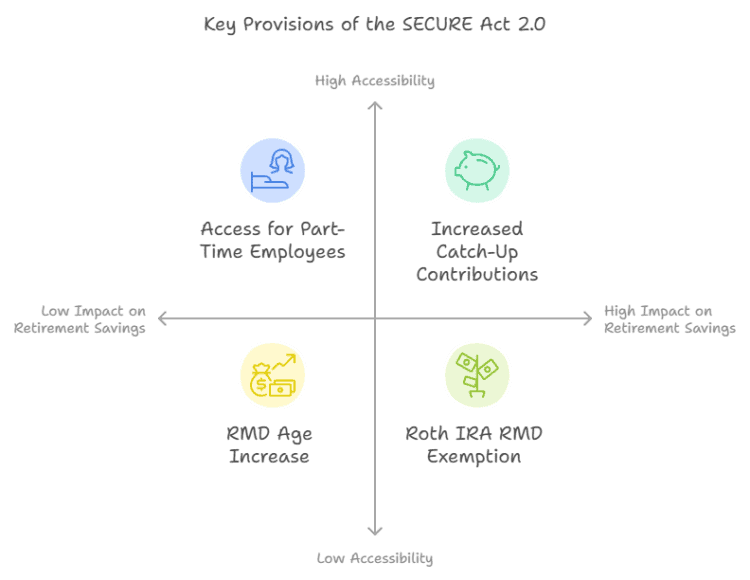
In 2026, the SECURE Act will allow older workers (60-63) to supercharge their savings with a $11,250 catch-up contribution ($7,000 if under 50), while part-time employees gain access to retirement plans after two years of qualifying work.
Roth IRA holders will benefit from tax-free growth without RMDs, providing more flexibility in managing retirement income.
What Exactly Is the SECURE Act and How Does It Affect Your Retirement?
The SECURE Act’s latest updates in 2026 bring three major game-changing benefits that’ll revolutionize how you plan for retirement. You’ll have more opportunities to boost your retirement savings through increased catch-up contributions.
While automatic 3-10% enrollment guarantees you won’t miss out on employer plans. Studies show that 90% of workers stay enrolled when retirement plans feature automatic enrollment.
Plus, these plan amendments help if you’re working part-time, you’ll finally have access to the retirement benefits you deserve.
Increased Catch-Up Contributions: A Game-Changer for Older Workers
In 2026, workers aged 60-63 will enjoy catch-up contributions of up to $11,250, significantly higher than the standard contribution limits. For workers under 50, the limit remains $7,000, providing a strong incentive to maximize contributions in the final years before retirement. So start a Roth IRA today if you haven’t already!
Interactive Retirement Savings Calculator
Use this calculator to determine how much you need to save each month for retirement based on your current savings, desired retirement age, and expected expenses.
Key Changes Breakdown
| Change type | Old rule | New rule (SECURE 2.0) |
|---|---|---|
| RMD penalties on missed withdrawals | IRS excise tax was 50% of the missed required minimum distribution. | Excise tax reduced to 25%, and 10% if corrected in the IRS-approved window.[web:13] |
| Roth 401(k) and Roth 403(b) RMDs | Employer-plan Roth accounts were subject to required minimum distributions. | No RMDs from Roth employer plans starting in 2024, aligning with Roth IRAs.[web:17] |
| 529 plan rollovers to Roth IRA | 529 college savings funds generally could not be rolled into a Roth IRA. | Certain long-held 529 plans can roll up to $35,000 lifetime into a Roth IRA, subject to limits.[web:17] |
| Employer match tax treatment | Matching contributions had to go into pre-tax accounts only. | Employees can elect to receive employer matches as Roth contributions where plans allow.[web:17] |
RMD Flexibility: More Time for Growth
Starting in 2026, retirees will enjoy greater flexibility with RMDs, now delayed until age 73. And those born after 1960 won’t have to start taking RMDs until age 75.

For seniors, the extension of the RMD age means you’ll have more time for your investments to grow tax-deferred. RMDs, which are the minimum amounts you must withdraw from tax-deferred retirement accounts like 401(k)s and IRAs.
For seniors worried about the impact of taxes, the reduction in penalties for missed RMDs—from 50% to 25%. With the possibility of reducing it further to 10% if the mistake is corrected promptly. This reduction offers peace of mind, allowing retirees to fix mistakes without facing huge penalties.
These changes address core seniors’ concerns about preserving wealth and managing taxes effectively. Good-faith interpretations will be accepted while the IRS finalizes these regulations. The new regulations were established to prevent retirement accounts from becoming permanent tax shelters.
Here’s what you need to know: Understanding the RMD aggregation rules, taking advantage of Qualified Charitable Distributions, and selecting the correct RMD Tables is crucial for accurate calculations.

Roth IRA Benefits: Tax-Free Growth with No RMDs
One of the major benefits of the SECURE Act is that Roth IRAs will no longer require RMDs. This means more flexibility for tax-free growth in your retirement savings, giving you greater control over your income strategy.
Retirement Readiness Quiz
Take this quick quiz to assess your retirement readiness!
Part-Time Workers Gain Access to Retirement Plans
Part-time employees will have access to retirement plans after two years of working at least 500 hours annually. This change opens up retirement options for millions of part-time workers who may have missed out on retirement benefits in the past.
| Benefit | What you get | How it helps |
|---|---|---|
| Catch-up boost (ages 60–63) | Up to about $11,250 extra catch-up room starting in 2025.[web:40][web:41] | Lets late‑career workers accelerate 401(k)/403(b) savings in the final years before retirement. |
| Automatic enrollment in new plans | Default deferral between 3% and 10% of pay in many new 401(k)/403(b) plans.[web:42][web:46][web:50][web:54] | Starts your retirement contributions automatically so you build savings without having to opt in. |
| Part‑time worker access | Long‑term part‑time employees become eligible to defer after as little as 500 hours in two years.[web:43][web:47][web:51][web:55] | Extends retirement plan access to more part‑time workers who previously could not participate. |
| Lost plan search tool | New DOL Retirement Savings Lost & Found online database for old plans.[web:44][web:48][web:52][web:56] | Helps you track down forgotten 401(k) or pension benefits after job changes or mergers. |
These changes aren’t just updates – they’re your pathway to a more secure retirement future.
What the SECURE Act Changes Mean for Retirement Accounts & RMDs
To make the most of these changes, consider adjusting your strategy. Here’s how:
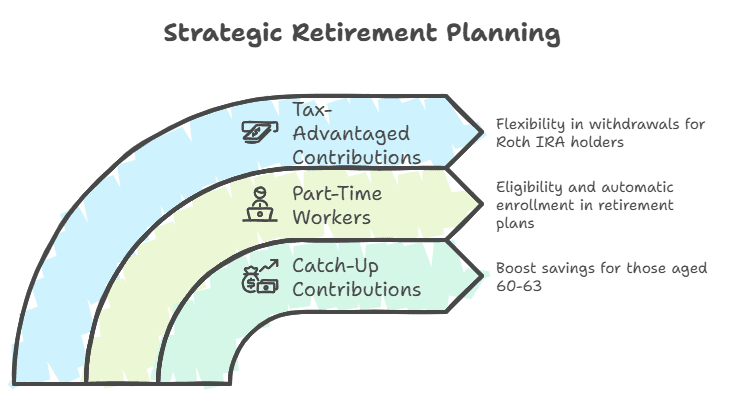
- Maximize Catch-Up Contributions: If you’re aged 60-63, now’s the time to increase contributions to your 401(k) or IRA. This is your opportunity to boost savings in the final years before retirement.
- Part-Time Workers: Check if you’re eligible to participate in retirement plans and take advantage of the automatic enrollment features that ensure you’re saving for the future.
- Tax-Advantaged Contributions: Roth IRA holders will benefit from the elimination of RMDs, providing flexibility in your retirement withdrawals.
Real-Life Examples: How These Changes Help
Late-Career Worker: Sarah’s Strategy
Sarah, a 62-year-old marketing manager, worries about having enough for retirement. By taking advantage of the $11,250 catch-up contribution, she increases her 401(k) contributions and significantly boosts her savings. As a result, Sarah feels more confident and financially prepared for retirement.
Part-Time Worker: John Gets Access to Retirement
John, a part-time teacher and online business owner, has never had access to retirement plans. Thanks to the SECURE Act, he now qualifies for his employer’s retirement plan after two years of working 500+ hours annually. This new opportunity allows him to start saving for retirement without extra effort.
Strategic Withdrawal Considerations
- Balance traditional and Roth contributions
- Manage inherited IRA distributions within 10-year window
- Avoid higher tax bracket triggers
- Consider Roth catch-up contributions for high earners
Tax Optimization Strategies
| Approach | Benefit |
|---|---|
| Spread distributions | Stay in lower tax brackets |
| Time withdrawals | Minimize tax impact |
| Early withdrawal planning | Manage future income expectations |
The SECURE Act provides flexible tools to maximize retirement savings while minimizing tax liabilities, empower
1. Maximizing Contributions
- Step-by-Step Guide: Set up automatic transfers from your checking account to your retirement account to ensure you consistently contribute. Start small and gradually increase your contributions as your financial situation improves.
- Example: Consider setting a reminder every month to review your budget and increase your contributions by a small percentage.

2. Navigating RMDs
- Planning for RMDs: Strategically plan your RMDs by timing withdrawals to minimize tax impact. For instance, if you expect a lower income in a particular year, that might be the best time to take larger distributions.
3. Using Financial Tools
- Retirement Calculators: Use online retirement calculators to visualize how much you need to save each month to reach your retirement goals. Tools like our retirement calculator can provide personalized estimates based on your current savings and desired retirement age.
- Budgeting Apps: Consider using budgeting apps like Mint or YNAB (You Need A Budget) to track your spending and identify areas where you can increase your retirement contributions.
Key RMD Dates to Remember
| Action Item | Deadline Reminders |
|---|---|
| First RMD | April 1 following year you turn 73 |
| Annual RMDs | December 31 each year |
| Account Review | Quarterly check-ups recommended |
| Tax Planning | Year-round monitoring needed |
Penalty Reduction Strategy
- Correct missed RMD promptly
- Respond within the IRS correction window
- Take missed distribution immediately
- Document reasonable cause for potential waiver
Strategic Implications & Recommended Actions
- Consult with financial advisor
- Review RMD deadlines
- Strategize withdrawal timing
- Maximize tax-deferral benefits
Conclusion: Take Control of Your Retirement: SECURE Act Strategies

Strategic Action Plan: Contribution Optimization
- Maximize catch-up contributions
- Review employer plan details
- Balance traditional and Roth contributions
- Consider Roth conversions before RMDs
Tax Management
- Strategically time withdrawals
- Avoid higher tax bracket triggers
- Explore Qualified Charitable Distributions
- Monitor inherited IRA 10-year distribution rules
Practical Considerations
| Focus Area | Key Strategy |
|---|---|
| Budget | Increase retirement contributions |
| Tax Planning | Minimize tax liability |
| Withdrawal Timing | Optimize RMD strategies |
| Account Management | Consolidate and review regularly |
Critical Deadlines
- First RMD: April 1 following age 73
- Annual RMDs: December 31
- Catch-up contribution review: Annually
- Employer plan assessment: Before year-end
Recommended Next Steps
- Consult financial advisor
- Review retirement account strategy
- Assess catch-up contribution potential
- Update tax planning approach
Transform retirement planning by proactively leveraging the SECURE Act’s new opportunities.
