
Webull itself is not an FDIC-insured bank. But eligible settled cash enrolled in Webull Cash Management can be swept to participating banks and become eligible for FDIC insurance there. Securities held in a Webull Financial brokerage account are generally protected by SIPC, not FDIC insurance.
That distinction matters more than a simple yes-or-no answer. The question I want you to ask is not just, “Is Webull insured?” Ask where is my money sitting right now?
That gives you the rule for the entire article. The logo on the app does not determine the protection. The location and legal status of the money do.
The 30-Second Webull Protection Map
- Stocks, ETFs, bonds and other eligible securities: think SIPC, plus applicable excess SIPC.
- Brokerage cash that has not been swept: think SIPC cash protection.
- Eligible settled cash actually swept to a Cash Management program bank: think FDIC at that bank.
- Market losses, trading mistakes or ordinary price declines: neither FDIC nor SIPC makes you whole.
On This Page
- Is Webull FDIC Insured? The 2026 Answer
- FDIC vs. SIPC at Webull: The Difference That Matters
- How Webull Cash Management Gets FDIC Coverage
- How SIPC Protects a Webull Brokerage Account
- Webull’s Excess SIPC Coverage Depends on the Clearing Arrangement
- What Webull Insurance Does Not Protect You From
- Is Webull Safe and Legit? What Regulation Proves and What It Doesn’t
- Is Webull Safe for More Than $500,000?
- My Bottom Line on Webull Account Safety
- Frequently Asked Questions About Webull FDIC and SIPC Coverage
- Sources
- How We Verified This
Is Webull FDIC Insured? The 2026 Answer

The clean answer is Webull Financial LLC is a brokerage firm, not an FDIC-insured bank, so securities in your Webull brokerage account are not FDIC-insured deposits.
However, Webull’s current SIPC and FDIC disclosure says eligible uninvested cash enrolled in Cash Management can be swept to participating banks. Webull currently advertises total FDIC eligibility of up to $5 million across its program-bank network, subject to the normal limits at each bank.
| Where your money is | Primary protection | What matters |
|---|---|---|
| Stocks, ETFs, bonds and other eligible securities in a Webull Financial brokerage account | SIPC plus applicable excess SIPC | SIPC addresses missing eligible customer property if a member brokerage fails. It does not insure investment performance. |
| Cash held as brokerage cash and not swept to a program bank | SIPC cash protection | Standard SIPC protection has a $250,000 cash sublimit inside its $500,000 customer limit. |
| Eligible settled cash swept through Cash Management to participating banks | FDIC deposit insurance at the receiving bank | Webull advertises up to $5 million across the network, but the $250,000-per-bank ownership rules still apply. |
| Futures or products outside the covered securities account | Depends on the product | Webull states that futures accounts are not protected by SIPC. |
Same app. Different assets. Different safety nets.
Know Which Safety Net You’re Actually Using
If the difference between brokerage cash, a bank sweep, and SIPC-covered securities was not obvious before this page, you are exactly the reader I write for.
- Know when FDIC coverage actually begins and when it does not.
- Understand what SIPC protects before a scary brokerage headline appears.
- Catch the fine print behind cash sweeps, large balances and account-safety claims.
Get one practical money decision rule each week.
FDIC vs. SIPC at Webull: The Difference That Matters
FDIC protects qualifying bank deposits

The Federal Deposit Insurance Corporation protects qualifying deposits if an FDIC-insured bank fails. The standard amount is $250,000 per depositor, per insured bank, for each ownership category.
FDIC insurance does not cover a stock, ETF, bond or mutual fund simply because you bought it through an app that also offers an FDIC sweep program. Those are investment products, not insured bank deposits.
SIPC protects eligible customer property at a failed brokerage
The Securities Investor Protection Corporation answers a different problem. If an SIPC-member brokerage fails and eligible customer securities or cash are missing, SIPC works through the liquidation process to restore customer property, subject to its rules and limits.

Standard SIPC protection is up to $500,000 per customer in each separate capacity, including up to $250,000 for cash.
The words separate capacity matter. Two ordinary individual brokerage accounts in the same name generally do not create two separate $500,000 limits merely because they have different account numbers. SIPC combines accounts held in the same capacity.
Different capacities can receive separate treatment. SIPC gives examples that include an individual account, joint account, traditional IRA and Roth IRA.
FDIC answers a bank-failure question. SIPC answers a brokerage-failure question. Neither answers whether your investment will lose value.
How Webull Cash Management Gets FDIC Coverage
Webull Cash Management is why a flat statement that “Webull is not FDIC insured” is incomplete.
Under the program, eligible uninvested settled cash can be swept from your brokerage account to a network of participating FDIC-insured banks. Webull currently says the arrangement can provide up to $5 million in total FDIC coverage, with no more than $250,000 of coverage at each program bank before your other same-category deposits at that bank are considered.
Webull’s current Cash Management documentation says the program is available for eligible Cash, IRA, Joint and Entity accounts. Margin accounts are not supported. Webull also publishes its current list of participating banks there and warns that the network can change.
But “up to $5 million” is a program ceiling, not a new FDIC limit. The underlying rule remains generally $250,000 per depositor, per insured bank, per ownership category.
The FDIC’s pass-through insurance guidance adds an important wrinkle. Deposits held through a third-party arrangement are not a new ownership category. Your swept deposit can be combined with deposits you already own at the same bank in the same ownership category.
The $350,000 Example
Suppose Webull sweeps $250,000 of your single-owner cash to Bank A. You already have $100,000 in single-owner deposits at Bank A.
You should not assume all $350,000 is separately insured merely because $250,000 reached the bank through Webull. For FDIC purposes, same-bank deposits in the same ownership category are generally aggregated.
Before relying on Webull’s $5 million number, check four things
- Are you enrolled in Cash Management? Webull says cash outside the program remains under SIPC protection rather than FDIC bank-sweep coverage.
- Has the money actually been swept? FDIC insurance applies to the qualifying deposit at the insured bank. A cash figure appearing in your brokerage app does not by itself prove the money has reached a program bank.
- Which banks received your money? Other deposits you already own at those banks can reduce your remaining FDIC coverage.
- Do the records support pass-through coverage? Pass-through treatment depends on the custodial or agency relationship and required recordkeeping.
For a modest cash balance, you may never get close to these boundaries. For a seven-figure cash balance, I would look at the actual program-bank allocation before treating a marketing maximum as my personal insured amount.
How SIPC Protects a Webull Brokerage Account
Webull Financial LLC is an SIPC member. If a member brokerage fails, properly recorded customer securities are generally handled as customer property through the brokerage-liquidation process. SIPC becomes especially important when eligible property that should be in customer accounts is missing.
This is why I would not look at a $600,000 stock portfolio and automatically say, “You have $100,000 uninsured.” That imports a bank-deposit mental model into a brokerage problem.
Suppose your account records show 2,000 shares of a stock and those shares are properly held as customer property. The normal objective is to return or transfer the securities. It is not to write you an insurance check for the current market value of the entire account.
The SIPC limits matter when eligible customer property is missing and there is a shortfall.
The $500,000 Misunderstanding
SIPC’s $500,000 limit does not mean every dollar of brokerage assets above $500,000 disappears if the broker fails.
The starting question is whether your securities and cash are actually present as customer property. SIPC protection becomes critical when eligible property is missing.
And there is no protection from an investment simply being a bad investment. If a stock falls 60%, neither SIPC nor FDIC restores that market loss.
Webull’s Excess SIPC Coverage Depends on the Clearing Arrangement
This is one place where older Webull articles can easily become misleading.
You may still see one Apex excess-insurance number repeated as though every Webull securities account has the same arrangement. Webull’s current disclosures describe two excess-SIPC structures depending on the clearing arrangement.
| Clearing arrangement | Current Webull disclosure |
|---|---|
| Securities accounts under Webull’s omnibus clearing relationship with Apex | Webull says its Lloyd’s policy has a $100 million aggregate limit, a $1.9 million maximum for any one customer’s cash, and no per-account sublimit for securities positions. |
| Securities accounts fully disclosed to the clearing firm | Webull says Apex’s additional policy has a $150 million aggregate limit, with maximums of $37.5 million for one customer’s securities and $900,000 for one customer’s cash. |
Those figures are aggregate policy limits and sublimits. They are not promises that every customer’s loss up to those amounts will automatically be reimbursed. Excess SIPC still concerns missing eligible customer property. It does not insure market performance.
If I had a very large account and the excess policy materially affected my comfort level, I would verify which clearing arrangement actually applies to my account rather than relying on an old article or remembered insurance number.
What Webull Insurance Does Not Protect You From
FDIC and SIPC are valuable protections. They are also narrower than the word insured can make them sound.
- Market losses. If your investments fall in value, SIPC does not replace the decline.
- Every cyber or fraud loss. FDIC and SIPC are not universal account-takeover, phishing or identity-theft insurance.
- Immediate access. An institution can be legitimate and protected while transfers, settlement, verification or a liquidation process still takes time.
- Futures accounts. Webull states that futures accounts are not protected by SIPC.
- Every product carrying the Webull name. Webull Financial, Webull Advisors, Webull Futures and other affiliated products are not one interchangeable legal bucket.
One concern I have seen repeatedly with brokerage insurance is that people use insured as shorthand for nothing bad can happen to me. That is not what either system promises.
Insurance against an institution failure, protection of customer property, cybersecurity risk, operational access and investment risk are separate questions.
Is Webull Safe and Legit? What Regulation Proves and What It Doesn’t
Webull Financial LLC is a legitimate U.S. broker-dealer. Webull states that it is registered with the SEC and is a member of FINRA and SIPC. That places its securities business inside the U.S. broker-dealer regulatory framework.
But registration is a floor, not an endorsement. It does not mean the government recommends Webull, guarantees uninterrupted access to the platform or protects you from investment losses.
If your question is whether the platform itself is a good fit—not just how the account is protected—my Webull Review covers the current fees, tools, strengths, drawbacks, and investor fit.
Is it safe to give Webull your Social Security number and ID?
The request itself is normal when opening a U.S. brokerage account. FINRA’s Customer Identification Program notice explains that financial firms must obtain identifying information when opening accounts. That can include a taxpayer identification number and identifying documents.
That explains why Webull asks. It does not make data security irrelevant. Use the official app or site, use a unique password, enable the account-security controls available to you, and treat unexpected requests for credentials or security codes as suspicious.
Is Webull Safe for More Than $500,000?
There is no useful one-number answer because the right analysis changes with the asset.
Michael’s Large-Balance Rule
Large securities balance?
Check the account registration, standard SIPC capacity, applicable excess-SIPC arrangement, and whether you are comfortable concentrating operations at one brokerage.
Large cash balance?
Check whether the cash is actually enrolled in Cash Management, which program banks received it, how much sits at each bank, and what other same-category deposits you already have there.
Large balance waiting to be invested?
Do not confuse protection from institution failure with protection from the investment you are about to buy.
Spreading assets across firms can sometimes reduce operational concentration or make account management more comfortable. I would not do it mechanically just to stay below $500,000 without first understanding what SIPC’s $500,000 figure actually applies to.
This is also where I would slow down before moving a seven-figure portfolio just to capture a temporary promotion. The larger the account, the more I care about custody, clearing, transfer mechanics and operational concentration alongside the headline bonus or yield.
My Bottom Line on Webull Account Safety
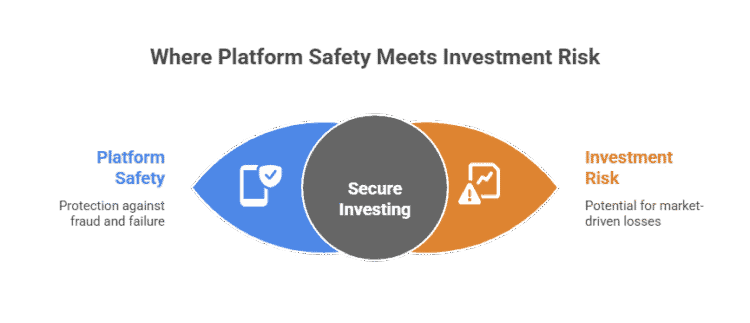
Webull Financial is a regulated brokerage with SIPC protection for eligible securities accounts. Eligible cash enrolled in Webull Cash Management can receive FDIC insurance after it is swept to participating insured banks.
But I would not stop at either sentence. Before putting a meaningful amount of money anywhere, I want to know what I own, who has custody of it, where my cash is actually sitting and which protection applies if something fails.
For Webull, that means:
- Use FDIC thinking for qualifying deposits actually swept to participating program banks.
- Use SIPC thinking for eligible securities and brokerage cash at Webull Financial.
- Use the applicable excess-SIPC disclosure for a very large securities account instead of assuming one Apex insurance limit applies to every account.
- Use security and operational controls for the separate risks of account takeover, fraud, transfer problems and access delays.
Safety gets much easier to judge once you stop asking one insurance question about four different risks.
Frequently Asked Questions About Webull FDIC and SIPC Coverage
Is money in Webull FDIC insured?
Not all of it. Securities in a Webull brokerage account are not FDIC-insured deposits. Eligible settled cash enrolled in Webull Cash Management can be swept to participating FDIC-insured banks. Webull currently says the program can provide up to $5 million of total FDIC coverage across the network, subject to normal FDIC limits and conditions.
What happens if Webull goes out of business?
For a Webull Financial securities account, customer property would be handled through the brokerage-failure process. SIPC protection can apply when eligible securities or cash that should be in customer accounts are missing. The purpose is not to insure the market value of your portfolio. It is to help restore eligible customer property.
Does SIPC cover more than $500,000 at Webull?
Standard SIPC protection is generally up to $500,000 per customer in each separate capacity, including a $250,000 cash limit. Webull also discloses excess-SIPC coverage, but the terms depend on the clearing arrangement. Excess SIPC is not market-loss insurance.
Is Webull Cash Management the same as a bank account?
No. Cash Management is a brokerage cash-sweep program. Eligible cash is moved to participating FDIC-insured banks. The FDIC protection comes from the qualifying deposit at those banks. Webull Financial itself does not become an FDIC-insured bank.
Is Webull Cash Management available for margin accounts?
No. Webull’s current Cash Management documentation says the program is not supported for margin accounts. Eligible Cash, IRA, Joint and Entity accounts can participate, subject to Webull’s current eligibility rules.
Can I have more than $250,000 of FDIC insurance through Webull?
Potentially, yes. Webull distributes eligible Cash Management deposits across multiple program banks and currently advertises up to $5 million of total FDIC eligibility. The important limitation is that coverage remains subject to the normal $250,000-per-bank ownership rules. Deposits you already hold at the same program bank can count toward that limit.
Is Webull safer than Robinhood or Fidelity?
This page does not rank brokerages. SIPC membership is a baseline protection shared by many U.S. brokerage firms, while bank-sweep programs, excess insurance, security controls, clearing arrangements and operating practices can differ. Compare the actual account structure rather than choosing based on one insurance acronym.
Sources
- Webull: SIPC and FDIC Insurance
- Webull: Cash Management Program
- Webull: Disclosures and Current Excess SIPC Terms
- SIPC: What Is SIPC?
- SIPC: Investors With Multiple Accounts
- FDIC: Understanding Deposit Insurance
- FDIC: Pass-through Deposit Insurance Coverage
- FINRA: Customer Identification Program Notice
How We Verified This
These are the authorities and references used to verify the material facts in this article.
