
Webull is a legitimate, low-cost brokerage with far more long-term investing capability than it used to have—but its strongest features still revolve around trading. In 2026, you can use Webull for stocks, ETFs, recurring investments, IRAs, mutual funds, bonds, cash management, and even a separate automated advisory service.
The bigger question is whether all of its charts, options tools, order flow, screeners, event contracts, and margin features help you invest better. Or simply give you more reasons to touch a portfolio that may have been better left alone.
That is the lens I would use for this Webull review. The platform is no longer easy to dismiss as “just for traders.” But for an ordinary long-term investor, the best feature may be the ability to automate a boring plan and then ignore most of what makes Webull interesting.
How I reviewed Webull: For this 2026 update, I checked Webull’s current product, fee, transfer and account-protection disclosures. I compared them with the questions people are actually asking me, and reviewed recent client discussions for recurring friction. This is an experienced expert evaluation of the brokerage and its fit for different investors. Not a claim that I personally placed live trades on every current Webull feature.
Show the quick answer
- Best fit: Webull is strongest for investors who want advanced trading tools, options, screeners, order flow, paper trading and a highly customizable platform.
- Long-term investing: Webull now supports recurring stock and ETF purchases, IRAs, bonds, mutual funds in eligible IRA use cases, cash management and a separate robo-advisory service, so long-term investors have more options than older reviews suggest.
- Safety: Webull Financial is an SEC-registered broker-dealer and FINRA/SIPC member. SIPC protects eligible brokerage assets if the broker fails; it does not protect you from investment losses. Eligible Cash Management deposits may receive FDIC coverage through partner banks.
- Main drawback: The platform makes trading unusually easy and engaging. That can be a benefit for an active trader and a behavioral liability for someone whose best plan is to buy diversified investments regularly and leave them alone.
- Michael's takeaway: Webull can be a perfectly usable long-term brokerage. The real test is whether you can use the boring tools and ignore the toys.
On This Page
- My 2026 Webull Verdict: Capable Enough for Investing, Designed to Make Trading Easy
- What Changed at Webull? More Than the Old Review Suggested
- Is Webull Good for Long-Term Investors?
- If Your Real Goal Is Long-Term Investing
- Why Active Traders Still Have the Strongest Case for Webull
- Webull Fees: “Commission-Free” Does Not Mean Cost-Free
- Is Webull Safe? Separate Broker Failure From Market Risk
- Customer Service and Transfer Friction: Don’t Ignore the Boring Stuff
- Who Should Use Webull—and Who Should Think Twice?
- Webull Review FAQ
- Bottom Line: Webull Is Better for Long-Term Investors Than It Used to Be
- How We Verified This Webull Review
My 2026 Webull Verdict: Capable Enough for Investing, Designed to Make Trading Easy
Older descriptions of Webull as a platform for traders and almost nobody else have become stale. Webull’s current investing lineup now includes enough of the plumbing a long-term investor might want: recurring purchases, retirement accounts, fixed income, mutual funds in supported IRA use cases, custodial accounts, cash management, and a separate automated advisory service.
But product capability is not the same thing as product fit.
A brokerage can be technically capable of long-term investing and still be behaviorally wrong for a long-term investor.
Webull’s own product pages emphasize advanced charting, custom indicators, stock screeners, options analysis, order flow, paper trading, sophisticated order types and fast execution tools. Those are legitimate features. They are also features designed to keep an investor looking at the market.
If your plan is to research and trade individual securities, that may be exactly what you want. If your plan is a diversified ETF portfolio funded automatically for the next 20 years, you should ask a different question: does this platform help me follow my plan, or tempt me to keep improving a plan that was already good enough?
What Changed at Webull? More Than the Old Review Suggested
This is where the previous version of this review aged badly. Webull’s current platform is broader than it was when many of the usual criticisms were written.
| Feature | What Webull offers now | Why it matters |
|---|---|---|
| Stocks & ETFs | U.S.-listed stocks and ETFs with $0 commissions, subject to applicable regulatory/exchange fees. | Enough for a simple index-ETF portfolio or individual-stock strategy. |
| Recurring investing | Scheduled purchases of eligible stocks, ETFs and supported portfolios, including IRA accounts. | A long-term investor can automate contributions instead of manually trading every month. |
| Fixed income | Treasuries and corporate bonds, including fractional bond investing with minimums as low as $100 on supported offerings. | The old “no bonds” criticism is no longer accurate. |
| Mutual funds | Eligible U.S.-domiciled mutual funds are available in Webull IRAs; availability varies by fund. | The old “no mutual funds” criticism also needs qualification. |
| Automated management | Webull Advisors offers managed portfolios based on risk and strategy choices. | Investors who do not want to choose and rebalance everything themselves have a separate managed option. |
| Cash management | Eligible uninvested cash can be swept to partner banks through Cash Management. | Cash protection and yield treatment are different from ordinary brokerage cash and securities. |
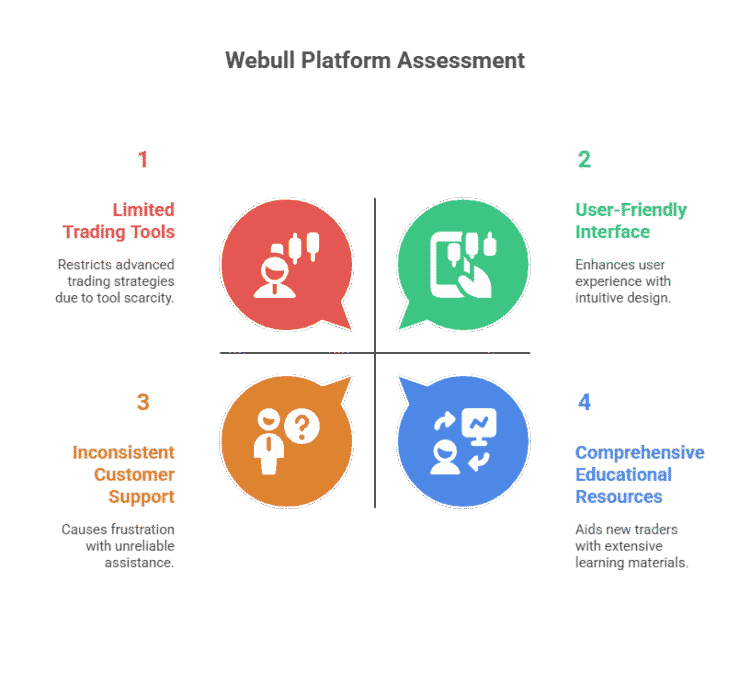
That does not suddenly make Webull the default brokerage for every household. It does mean the decision should be based on how you intend to use it now—not on a 2023 feature list.
Is Webull Good for Long-Term Investors?
Yes, Webull can work for a long-term investor. You can build a simple stock-and-ETF portfolio, schedule recurring investments, use an IRA, hold cash, access bonds, and use an advisory account if you want automated portfolio management.
The practical concern is not that Webull makes long-term investing impossible. It is that its most differentiated features point in the opposite direction.
- Advanced technical charts make it easy to study short-term price movement.
- Paper trading makes strategy testing easy.
- Options tools, screeners and order flow encourage active decision-making.
- Margin creates the ability to borrow against the account.
- Event contracts, futures and other trading products expand the number of things you can act on.
None of those features is inherently bad. The mismatch happens when someone says, “My plan is to buy broad-market ETFs every payday and leave them alone,” then chooses a platform because it has the most interesting trading dashboard.
Michael’s rule: For a long-term investor, the best brokerage is often the one that makes the right behavior easy and the unnecessary behavior boring.
A June 2026 discussion in r/Webull captured the tension unusually well: a user had moved to Webull to learn day trading, then asked how to separate those trades from a long-term portfolio. That does not prove Webull causes overtrading. It does illustrate a very real portfolio-management problem: once “investing” and “trading” share the same screen, it becomes easier to treat them as the same activity.
Why Active Traders Still Have the Strongest Case for Webull
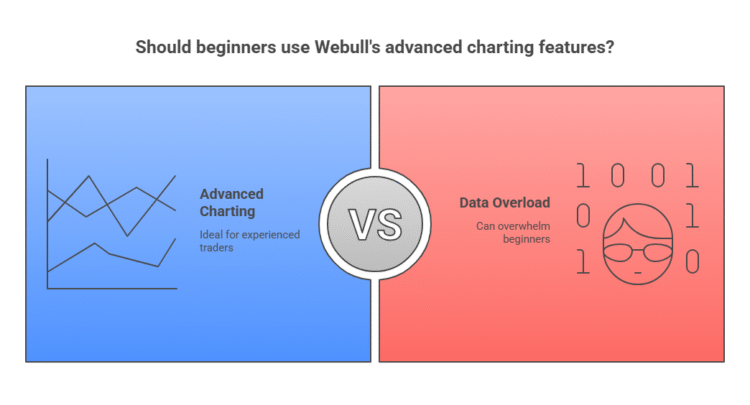
Webull still makes the most obvious sense when you actually intend to use the tools it emphasizes. Its current stock platform highlights customizable charting, technical indicators, stock and ETF screeners, advanced order types, order-flow data and paper trading. Its options platform adds screeners, volatility tools, multi-leg strategies, profit/loss diagrams and rapid execution features.
For a self-directed trader, those capabilities can replace several separate research and execution tools. For a new investor, they can also create the impression that successful investing requires constant analysis.
That distinction matters more than counting indicators. Webull is good at making market information actionable. A long-term investor needs to decide how often market information should lead to action.
Webull Fees: “Commission-Free” Does Not Mean Cost-Free
Webull currently advertises $0 commissions for U.S.-listed stocks, ETFs and stock/ETF options in eligible self-directed accounts, although regulatory, exchange and certain specialized option fees can still apply. That is genuinely inexpensive for basic trading.
The costs that matter depend on what you actually use:
| Cost area | Current Webull treatment | What I would watch |
|---|---|---|
| Stocks & ETFs | $0 commission on eligible U.S.-listed trades. | Regulatory/exchange fees and the temptation to trade more simply because each trade feels free. |
| Equity options | $0 commissions and contract fees for many stock/ETF options; certain index and oversized orders can carry additional Webull fees. | The economic risk of the strategy matters far more than saving a small contract fee. |
| Mutual funds | Webull currently charges the lesser of 3% of the transaction amount or $14.95 for mutual fund purchases and sales, excluding money market funds. | For a long-term fund investor, a commission-free ETF may be a cleaner fit than repeatedly paying a transaction fee. |
| Margin | Interest applies to borrowed balances and rates can change. | Borrowing costs plus the increased loss risk from leverage. |
| Webull Advisors | Current annual advisory fees range from 0.15% to 0.30% depending on strategy, with a $1 monthly minimum when calculated fees are lower. | Small accounts can feel that $1 minimum more heavily as a percentage of assets. |
| Outgoing ACATS | Webull currently lists a $75 fee for full or partial outgoing account transfers. | Switching later is not necessarily free, and some assets may not transfer in kind. |
That is why I would not build a fake “true cost calculator” around payment for order flow or assume a hidden dollar cost per trade. The more decision-useful question is simpler: which paid features, borrowing costs, fund transaction fees, transfer costs or trading behaviors will your actual plan trigger?
Is Webull Safe? Separate Broker Failure From Market Risk
Webull Financial LLC is a registered U.S. broker-dealer and a FINRA and SIPC member. Webull’s current SIPC and FDIC disclosure says standard SIPC protection covers eligible securities and cash in a brokerage failure up to $500,000 per account category, including a $250,000 cash limit. Webull also states that it carries excess SIPC coverage subject to policy limits.
What SIPC does not do is reimburse you because a stock, ETF or option fell in value. Brokerage protection and investment risk are different problems.
FDIC coverage is another separate bucket. Webull’s Cash Management program can sweep eligible uninvested cash to a network of partner banks, where Webull currently states that deposits can receive FDIC insurance up to an aggregate $5 million, subject to the standard $250,000 limit per bank and any other deposits you already hold at the same bank in the same ownership category. If you are not enrolled in that program, Webull says brokerage cash is covered under SIPC rather than FDIC insurance.
I keep the full distinction on the dedicated Webull FDIC insurance page, and the broader brokerage-failure rules in my SIPC coverage guide. The important thing here is not to use the word “insured” as though all losses are protected. They are not.
Customer Service and Transfer Friction: Don’t Ignore the Boring Stuff
Brokerage reviews love feature grids. The annoying operational questions often matter more after you become a customer: How quickly can you get help? What happens when a transfer is rejected? How long are newly deposited funds held? What happens if your bank details do not match exactly?
Recent Reddit discussions still show users asking about failed withdrawals and transfer restrictions. Those reports are anecdotal and do not establish that Webull has a systemic withdrawal problem. They do show why support and transfer rules deserve space in a real review instead of being reduced to a star rating.
Webull’s current transfer-restriction guidance says outgoing ACATS can be rejected for issues such as unsettled trades, insufficient cash for the transfer fee, account-registration mismatches, incorrect account numbers, or certain option positions. Its outgoing-transfer guidance also says recent deposits may face a holding period of up to 30 days. A friction point can therefore be a compliance or settlement rule rather than evidence your money has disappeared.
My practical test is simple: if you expect frequent phone help, complex estate servicing or a lot of hand-holding, make customer service part of the brokerage decision—not something you investigate after the first problem.
Who Should Use Webull—and Who Should Think Twice?
| Investor | Webull fit | Reason |
|---|---|---|
| Active self-directed trader | Strong fit | Advanced charts, screeners, options tools, order flow, paper trading and customizable execution are central to the platform. |
| Long-term ETF investor | Can work well | Recurring investing, fractional shares and IRAs can support a simple plan—but most of the platform’s differentiation is unnecessary for this job. |
| Mutual-fund-first investor | Mixed | Mutual funds are now supported in eligible IRA use cases, but transaction fees and transfer limitations make the details important. |
| Investor who wants automated management | Possible fit | Webull Advisors offers separate managed portfolios for investors who do not want to manage every allocation themselves. |
| Investor who wants branches and extensive human support | Weaker fit | A digital-first brokerage is a different service model from a large branch-based brokerage. |
| Beginner attracted mainly by trading features | Proceed carefully | The platform makes sophisticated trading accessible before experience necessarily catches up. |
Notice what I am not doing here: giving Webull four stars for traders, two for retirees and one for beginners as though an investor type can be reduced to a rating. The better question is whether the platform’s strengths match the job you need the account to perform.
Webull Review FAQ
Is Webull legit?
Yes. Webull Financial LLC is a U.S. broker-dealer registered with the SEC and is a member of FINRA and SIPC. That tells you the firm operates inside the U.S. brokerage regulatory framework; it does not mean investments cannot lose value.
Is Webull good for beginners?
It can be, especially for a beginner who wants paper trading, fractional shares and room to grow into more advanced tools. But a brand-new investor who mainly needs diversified funds, automation and help staying out of their own way may find the trading-heavy interface offers more capability than they need.
Can you use Webull for long-term investing?
Yes. Webull supports recurring investments in eligible stocks and ETFs, IRAs, fixed income, cash management, and other tools that can support long-term investing. The question is behavioral fit, not basic capability.
Does Webull have mutual funds?
Yes, but the details matter. Webull currently offers eligible U.S.-domiciled mutual funds in Webull IRAs, and not every fund is available. Webull also currently charges a transaction fee on mutual fund purchases and sales other than money market funds.
Does Webull offer bonds?
Yes. Webull currently offers U.S. Treasuries and corporate bonds and advertises fractional bond investing with minimums as low as $100 on supported offerings. Account eligibility and available securities can vary.
Is Webull FDIC insured?
Webull itself is not a bank, and stocks and ETFs are not FDIC insured. Eligible uninvested cash enrolled in Webull’s Cash Management program may be swept to partner banks and receive pass-through FDIC insurance subject to program and per-bank limits. Brokerage securities are generally covered by SIPC rules instead.
Bottom Line: Webull Is Better for Long-Term Investors Than It Used to Be
The old version of this review made Webull sound like a choice between serious trading and serious investing. In 2026, that is too simplistic.
Webull can now handle a perfectly respectable long-term setup. You can automate ETF purchases, use retirement accounts, access bonds, hold certain mutual funds, keep eligible cash in a bank-sweep program, or hand portfolio management to Webull Advisors.
Its competitive personality, however, is still trading. That is where the platform feels most differentiated.
The decision is not “Can I invest long term at Webull?” You can. The decision is whether Webull makes it easier for you to follow your long-term plan—or easier to keep interrupting it.
If you are honest about that answer, the brokerage decision becomes much easier.
How We Verified This Webull Review
The platform, fee and account-protection details in this 2026 review were checked against current Webull disclosures and current regulatory/industry sources.
