
Estate tax and inheritance tax are not the same tax. Estate tax is generally imposed on the estate before assets reach heirs. Inheritance tax is imposed on certain beneficiaries after they inherit. The federal government has an estate tax, but no federal inheritance tax.

Quick Answer: Who Actually Pays?
Estate tax = the estate pays. Inheritance tax = the beneficiary may pay. In 2026, the federal basic estate-tax exclusion is $15 million per individual. State rules can matter at much lower estate values, and five states still impose an inheritance tax.
I spent more than 25 years as a financial advisor, and this is one of those tax questions that sounds harder than it is because people use the words interchangeably. Once you separate who is being taxed, most of the confusion disappears.
On This Page
- Key Takeaways Ahead
- Inheritance Tax vs. Estate Tax: The Pizza Analogy
- Estate Tax vs. Inheritance Tax: Who Pays Each?
- Federal Estate Tax in 2026: The $15 Million Exclusion
- Portability and Form 706: Why Some Smaller Estates Still File
- Which States Have an Inheritance Tax?
- Which States Have Their Own Estate Tax?
- Residency and Property Location: Which State Gets a Say?
- When Does Professional Estate-Tax Planning Become Relevant?
- What This Page Does Not Cover
- Bottom Line: Estate Tax Hits the Estate; Inheritance Tax Can Hit the Heir
- Sources
Key Takeaways Ahead
Inheritance Tax vs. Estate Tax: The Pizza Analogy
Imagine the estate is a pizza sitting on the table.
ELI5: Same Pizza, Two Different Taxes
Estate tax takes its bite from the whole pizza before the slices are handed out. Inheritance tax looks at your slice after you become the beneficiary and asks whether your state taxes that transfer to someone in your relationship class.
That difference sounds small. It is not. It determines who files, who owes the tax, which thresholds matter, and why your relationship to the person who died can matter for inheritance tax but usually not for federal estate tax.
Estate Tax vs. Inheritance Tax: Who Pays Each?
| Question | Estate Tax | Inheritance Tax |
|---|---|---|
| Who is taxed? | The estate | The beneficiary or heir |
| When is it measured? | Before distribution to heirs | Based on what a beneficiary receives |
| Federal version? | Yes | No federal inheritance tax |
| State version? | Yes, in some states and D.C. | Yes, in five states |
| Does family relationship matter? | Usually not for non-spouse beneficiaries; estate value and deductions drive the tax | Often yes; spouses and close relatives commonly receive better treatment |
If your real question is whether what you personally inherited is taxable income, that is a different page job. Start with Is Inheritance Taxable?. This page is about the transfer-tax system itself.
Federal Estate Tax in 2026: The $15 Million Exclusion
For someone who dies in 2026, the federal basic exclusion amount is $15 million. The executor generally must file Form 706 when the gross estate plus adjusted taxable gifts and certain prior exemptions exceeds that amount.
Federal estate tax is imposed on the taxable estate, not separately on each beneficiary’s inheritance. That is why saying, “My daughter inherited $2 million, so she owes federal estate tax,” starts with the wrong taxpayer.
Myth: “The Federal Government Takes 40% of My Inheritance”
The federal estate tax has a top rate of 40%, but that does not mean an heir automatically loses 40% of what they receive. The estate tax applies only after the estate-tax rules, deductions, credits, and available exclusion are taken into account.
Portability and Form 706: Why Some Smaller Estates Still File
This is the one federal estate-tax concept many married couples should at least know exists.
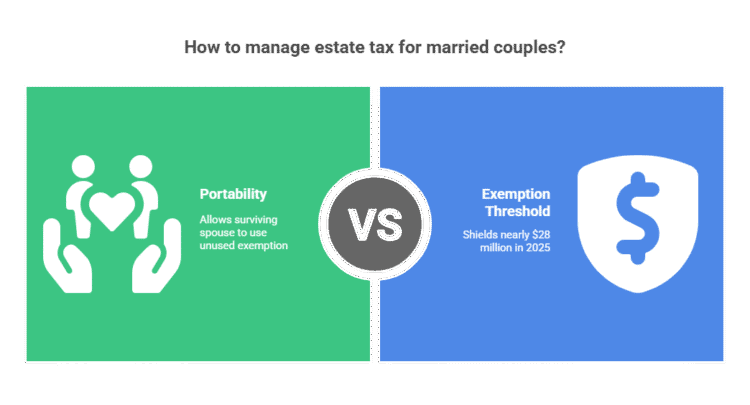
If the first spouse to die does not use all of their federal exclusion, the executor may be able to elect portability so the surviving spouse can use the deceased spouse’s unused exclusion, called the DSUE amount. The IRS says the election is made by filing a timely and complete Form 706—even when the first spouse’s estate is otherwise below the normal filing threshold.
Watch Out: “No Estate Tax Due” Does Not Always Mean “No Form 706 Decision”
A surviving spouse may benefit from portability even when the first estate owes no federal estate tax. That is an executor-and-advisor decision worth addressing while the filing window is still open, not years later when the surviving spouse’s estate has grown.
Which States Have an Inheritance Tax?
Five states currently impose an inheritance tax: Kentucky, Maryland, Nebraska, New Jersey, and Pennsylvania. Iowa completed its phaseout for deaths occurring on or after January 1, 2025.
| State | Maximum Rate | Why Relationship Matters |
|---|---|---|
| Kentucky | Up to 16% | Beneficiary classes receive different exemptions and rates |
| Maryland | 10% | Many close family members are exempt |
| Nebraska | Up to 15% | Exemptions and rates vary by relationship class |
| New Jersey | Up to 16% | Class A beneficiaries are treated differently from more distant heirs |
| Pennsylvania | Up to 15% | Rates vary substantially for spouses, descendants, siblings, and other heirs |
The key pattern is more important than memorizing every bracket: inheritance tax often cares who you are to the person who died. A spouse, child, sibling, niece, nephew, or unrelated friend may face very different treatment from the same estate.
Which States Have Their Own Estate Tax?
In addition to the federal system, 12 states and the District of Columbia impose their own estate tax: Connecticut, Hawaii, Illinois, Maine, Maryland, Massachusetts, Minnesota, New York, Oregon, Rhode Island, Vermont, and Washington, plus Washington, D.C.
This is where families can get surprised. State estate-tax exemptions can be far below the federal $15 million exclusion, so an estate can owe no federal estate tax and still have a state estate-tax problem.
Michael’s Take
The $15 million federal number gets all the attention because it is huge. But if you are doing real planning, the first question is not “Am I under $15 million?” It is “Which federal and state systems can actually reach this estate?”
Maryland is especially unusual because it is currently the only state imposing both an estate tax and an inheritance tax.
For a current state-by-state snapshot, see the Tax Foundation estate and inheritance tax table. State thresholds and rates can change, so verify the rules for the year of death before relying on a chart.
Residency and Property Location: Which State Gets a Say?
This is the part that causes some of the ugliest confusion because there may be three different places in the story: where the person who died was domiciled, where the beneficiary lives, and where real estate or other property is located.
Do not reduce this to “the heir’s state controls” or “the decedent’s state always controls.” Domicile is often central, but states can also assert taxing jurisdiction over property located inside their borders. Real estate is the obvious example.
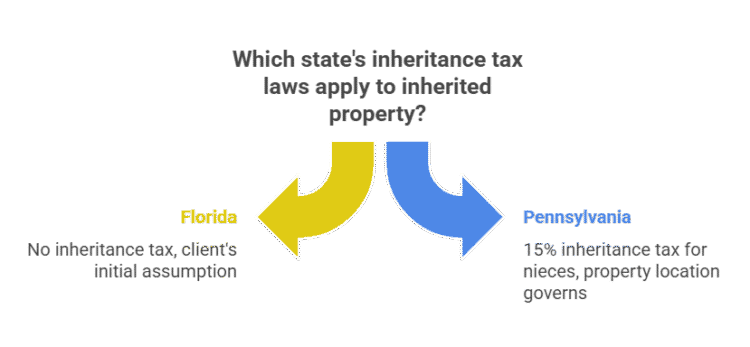
Example: Florida Heir, Pennsylvania Property
Living in a state with no estate or inheritance tax does not automatically erase another state’s claim. If an estate or inherited property has ties to a state that imposes one of these taxes, check that state’s rules before assuming “I live in Florida, so I’m safe.”
When Does Professional Estate-Tax Planning Become Relevant?
You do not need an advanced estate-tax strategy merely because someone died. But professional estate-tax help becomes much more relevant when one or more of these are true:
- The estate is approaching the federal filing threshold or has substantial lifetime taxable gifts.
- The decedent lived in—or owned substantial property in—a state with an estate or inheritance tax.
- A surviving spouse may benefit from a portability election.
- The estate includes a closely held business, hard-to-value assets, large real-estate holdings, or assets in multiple states.
- There is a non-U.S.-citizen spouse, nonresident decedent, foreign property, or other cross-border complication.
- The executor is unsure whether Form 706 is required or strategically useful even when no tax appears due.
Decision Rule
Before asking how to reduce the tax, identify the taxpayer and the jurisdiction. Estate or heir? Federal or state? Domicile or property location? Once those are clear, the planning question gets much smaller.
What This Page Does Not Cover
Estate and inheritance taxes are transfer taxes. They are not the same thing as capital-gains tax on an inherited asset, income tax on inherited retirement-account withdrawals, or the basic question of whether an inheritance is taxable when you receive it.
Those issues deserve their own rules instead of being stuffed into one giant inheritance-tax article. That is why this page stops here.
Bottom Line: Estate Tax Hits the Estate; Inheritance Tax Can Hit the Heir
The simplest way to remember the system is the pizza:
- Federal estate tax: tax on the estate, with a $15 million basic exclusion for 2026.
- State estate tax: tax on the estate in 12 states and D.C., often with much lower state thresholds.
- State inheritance tax: tax tied to what certain heirs receive in Kentucky, Maryland, Nebraska, New Jersey, and Pennsylvania.
- Portability: a Form 706 election that can preserve a deceased spouse’s unused federal exclusion for the surviving spouse.
