


You’ve spent hours deciding who inherits the house, who takes the dog, and which child can be trusted with the family silver. You’ve signed the will , shook your lawyer’s hand, and tucked that folder into a fireproof safe.
You think you’ve left an estate legacy.
But for many families in 2026, that folder is a ticking time bomb of procedural friction.
The truth is, a “valid” will can still be a functional failure at the courthouse. Without a specific Self Proving Will Affidavit, your will is a “non-self-proving” document. This means the court won’t just take your word for it, or your signature.
They will demand your witnesses show up in person to prove you actually signed it. If those witnesses are dead, missing, or just busy, your estate hits a wall.
🚀 Key Takeaways of Why You Need a Self Proving Affidavit
- Validity ≠ Probate Speed: A legally signed will can still be “stalled” for months without a self-proving affidavit.
- The Evidentiary Burden: Without this affidavit, the burden of proof shifts to your grieving family to find and produce witnesses in court.
- Statutory Precision Matters: In 2026, courts are backlogged; they require exact language from the Uniform Probate Code § 2-504 or state-specific codes like NJ Rev Stat § 3B:3-4.
- The Executor’s Nightmare: A missing affidavit turns a simple filing into a “Witness Hunt,” often requiring private investigators and thousands in legal fees.
Key Takeaways Ahead
What is a Self-Proving Will? Meaning & Definition

In legal terms, a self-proving will is one where the witnesses’ signatures are accompanied by a notarized affidavit. This affidavit acts as “pre-packaged testimony.”
It tells the court: “We saw the testator sign, they knew what they were doing, and we are swearing to it right now so we don’t have to do it later.“
Under the Uniform Probate Code (UPC) § 2-504, this document creates a “conclusive presumption” that the will was executed correctly.
💡 Michael Ryan Money Tip
Check the last page of your will. If you see two signature lines for witnesses and then another section below it with a notary seal and more signatures, you’re likely safe. If you only see one set of signatures, you’re leaving a $5,000 problem for your kids.
The Financial Impact: Self-Proving vs. Standard Wills
A standard signature proves you signed the document.
A Self-Proving Affidavit eliminates the need for your witnesses to appear in court after you die.
The difference between these two documents is measured in time and money. Below is the 2026 breakdown of what happens when a will enters the probate system.
Understanding the procedural difference between a Self-Proving Will and a standard document is the difference between a seamless inheritance and a costly legal bottleneck. This comparison highlights how a single Self-Proving Affidavit eliminates the need for live witness testimony, effectively shielding your estate from the high costs and lengthy delays of a contested or stalled probate process.
| Feature | Self-Proving Will | Standard “Valid” Will |
|---|---|---|
| Court Appearance | Not required for witnesses | Mandatory or via new affidavit |
| Probate Speed | Days/Weeks | Months/Years |
| Average “Fix-it” Cost | $0 | $2,500 – $7,000 |
| Risk of Challenge | Low (Execution is “conclusive”) | High (Open to “Technical” contests) |
The data clearly demonstrates that failing to include a Self-Proving Affidavit creates significant financial and temporal liability for your heirs. To secure your legacy, review your current document for statutory compliance or consult an estate specialist to execute a corrective codicil.
⚠️ Myth Busted
Many believe that notarization alone makes a will “official.” In reality, a notary signature without the specific Self-Proving Affidavit language is legally irrelevant for skipping the witness testimony requirement. It only proves you are who you say you are, not that the will execution was correct.
The Executor’s Nightmare: Administering the Unproven Will
When you name an executor, you are giving them a job. If your will is not self-proving, you are handing them a second, unpaid full-time job as a Private Investigator.
When the testator passes, the executor steps into the crosshairs. If the will is non-self-proving, the executor must perform a “Witness Hunt.” This is where the executor locates the witnesses and compels them to provide a “Proof of Execution” affidavit years after the original signing.
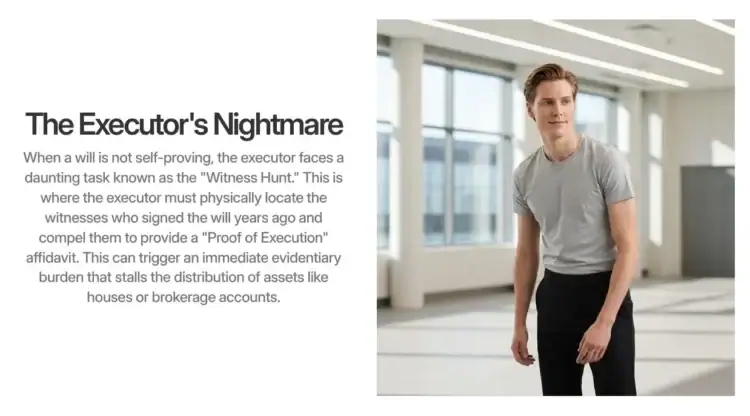
The executor must physically locate the witnesses to swear they saw the signing. If the law firm that drafted the will has closed, or the witnesses have moved out of state, the executor must file a “Diligent Search Affidavit” with the probate court. Often requiring a court-ordered search.
This triggers an immediate evidentiary burden that can stall the distribution of assets like houses or brokerage accounts. This requires documenting every phone call, letter, and Google search made to find them.
Only after the court is satisfied that the witnesses are truly “unavailable” can the executor use secondary evidence, such as handwriting analysis, to move the probate forward. This “Administrative Friction” is why many estates remain open for years, bleeding value through legal fees and court costs.
🔍 Related: Learn how to bypass the probate process entirely to keep your family out of the courtroom.
💡 Stop the Probate Bleeding
One clear financial move each week — straight from 28 years of seeing what goes wrong.
- → Probate avoidance checklists
- → State-specific “Magic Word” guides
- → Real stories of estate wins and fails
Get estate planning red flags delivered to your inbox each week.
📬 No spam. Unsubscribe anytime.
The Million-Dollar Question: Why would ANYONE want a non-self-proving will?
If a self-proving will is so much better, why do non-self-proving wills even exist? Is there a secret advantage?

The short answer: No. There is virtually no strategic advantage to having a non-self-proving will. It is a relic of a time before notarization was common, or the result of a “quick and dirty” execution.
⚠️ Myth Busted
There is no “tax loop-hole” or “privacy benefit” to skipping the affidavit. In fact, a non-self-proving will decreases privacy because it requires more court filings and public searches to validate.
Why wouldn’t an attorney create a self proving will?
In 28 years of practice, I’ve seen three reasons why an attorney might skip this:
- Old Habits: Some “old-school” practitioners grew up in jurisdictions where self-proving affidavits weren’t the norm until recently.
- Emergency Signings: If a will is being signed in a hospital bed or a “deathbed” scenario, a notary might not be immediately available. In these high-pressure moments, a “valid but unproven” will is better than no will at all.
- Process Gaps: Sometimes, it’s just plain old sloppiness… an attorney’s assistant forgets to bring the notary or the specific affidavit form.
Why you must insist on your will being self proving
You are the customer. You are paying for a document that is supposed to buy your family peace of mind. A non-self-proving will is like buying a car without a key. It looks great in the driveway, but it won’t go anywhere when you need it.
Insist on the affidavit because:
- It’s a “Set It and Forget It” Solution: Once it’s notarized, the witnesses’ job is done forever.
- It’s the Ultimate “Human Moat”: It prevents disgruntled heirs from challenging the will based on “technicalities” of the signing process.
- It’s Cheap Insurance: Adding a self-proving affidavit at the time of signing costs almost nothing (usually just the notary’s travel fee). Fixing it later costs thousands.
The R.E.A.L. Execution Framework
To ensure your will isn’t just a piece of paper, but an enforceable legal asset, I use the R.E.A.L. Framework.
The R.E.A.L. Check for Will Execution
To ensure your will doesn’t stall, it must pass the R.E.A.L. framework:
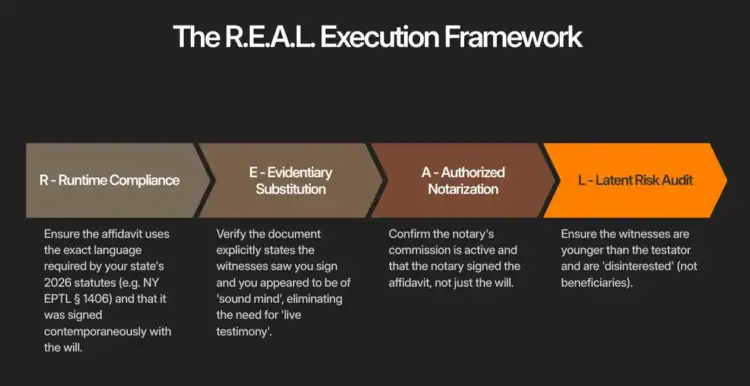
R — Runtime Compliance
✓ Does the affidavit use the exact language required by your state’s 2026 statutes? For example, in New York, the court looks for compliance with NY EPTL § 1406
✓ Was it signed contemporaneously with the will?
E — Evidentiary Substitution
✓ Does the document explicitly state the witnesses saw you sign and you appeared to be of “sound mind”?
✓ Does it eliminate the need for “live testimony”?
A — Authorized Notarization
✓ Is the notary’s commission active?
✓ Did the notary sign the affidavit, not just the will?
L — Latent Risk Audit
✓ Are the witnesses younger than the testator? (A practical “Information Gain” tip most advisors miss).
✓ Are the witnesses “disinterested” (not beneficiaries)?
What is the Harmless Error Doctrine? (The Trap)
You might hear about the Harmless Error Doctrine (based on UPC § 2-503) and think it’s a safety net. It allows a court to accept a defective will if there is “clear and convincing evidence” of the testator’s intent.
Here is the practitioner-level nuance competitors won’t tell you:
Relying on a judge’s discretion is a high-cost gamble. Scholars have observed that the majority of claims reviewed under harmless-error standards are ultimately deemed harmless and do not result in reversal. Why? Because the legal threshold for “clear and convincing evidence” is incredibly high.
⚠️ Don’t Stop Here: A missing affidavit is only one risk. See the other common estate planning errors that could derail your legacy.
State-Specific Reality: NJ, NY, and FL
- New Jersey: Under NJ Rev Stat § 3B:3-4, a will is made self-proving by the acknowledgment of the testator and the affidavits of the witnesses. If you did it during your life, it’s “Self-Proved.”(https://lis.njleg.state.nj.us/)]
- New York: Uses an “Affidavit of Attesting Witnesses” (NY EPTL 1406). It can be done at the time of execution or later, but “later” usually means your family is paying an attorney to do it.
- Florida: Very strict. FL Stat § 732.503 requires the signatures of the testator and witnesses to be notarized simultaneously.
- IRS Publication 559: Survivors, Executors, and Administrators
- The American College of Trust and Estate Counsel (ACTEC)
What This Means for Your Family
If you are looking at your estate plan today, do not check for your signature. Check for the Affidavit.
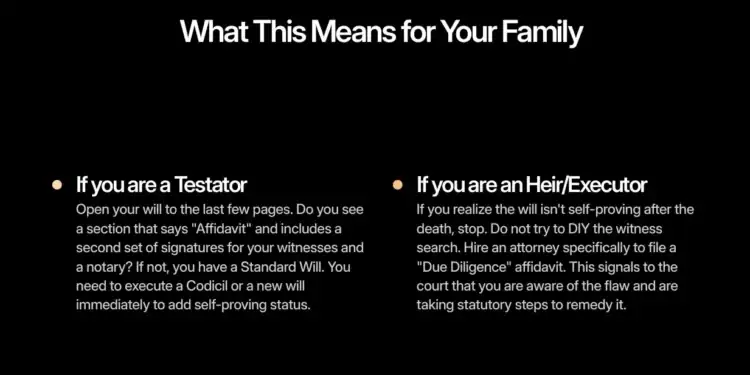
If you are a Testator:
Open your will to the last few pages. Do you see a section that says “Affidavit” and includes a second set of signatures for your witnesses and a notary?
If not, you have a Standard Will. You need to execute a Codicil or a new will immediately to add self-proving status.
If you are an Heir/Executor:
If you realize the will isn’t self-proving after the death, stop. Do not try to DIY the witness search. Hire an attorney specifically to file a “Due Diligence” affidavit. This signals to the court that you are aware of the flaw and are taking statutory steps to remedy it.
⚡ Bottom Line:
A missing self-proving affidavit is a “latent tax” on your estate. Adding it takes 10 minutes; ignoring it costs your family 10 months.
The Bottom Line
A non-self-proving will is a “half-baked” plan. It technically works, but only after your family does the heavy lifting of hunting down witnesses from decades ago.
What this means to you:
You are currently trading a 10-minute notarization today for a 10-month court battle tomorrow. Why it’s bad: It turns your grieving executor into a private investigator and drains your estate’s cash. What you can do: Look at your will right now. If you see signatures but no notary stamp on an “Affidavit” page, call your lawyer and ask for a “Self-Proving Codicil.”
Next Step:
Would you like me to generate a “3-Question Script” you can use when calling your attorney to ensure they aren’t skipping the self-proving language?
- Sharing the article with your friends on social media – and like and follow us there as well.
- Sign up for the FREE personal finance newsletter, and never miss anything again.
- Take a look around the site for other articles that you may enjoy.
Note: The content provided in this article is for informational purposes only and should not be considered as financial or legal advice. Consult with a professional advisor or accountant for personalized guidance.
