
Exponential growth in finance happens when growth builds on prior growth. Instead of adding the same dollar amount every period, the amount earned can become part of the base that earns the next return. That is the engine behind compound interest and compounding investment returns.
The curve starts slowly. Then, if the rate stays positive and earnings remain invested, the dollar growth can accelerate because each percentage gain is being applied to a larger balance.
Compounding is powerful, but I would not call it magic. The math is simple. The hard part is giving it enough time, keeping costs under control, and not confusing a hypothetical steady return with what markets actually deliver.
Show the short version
- What it is: Exponential growth means the amount of growth is tied to the current balance, so the dollar growth can accelerate as the balance gets larger.
- Finance connection: Compound interest is a classic financial example because interest can earn additional interest in later periods.
- Investing caveat: Investment returns are not a fixed interest rate. Gains and losses vary, so real portfolio growth will not follow a perfectly smooth exponential curve.
- Biggest driver: Time matters because later returns are being applied to a larger accumulated balance.
- What works against you: Fees, taxes, withdrawals, losses, and high-interest debt can all reduce or reverse the compounding effect.
- Best next step: Use the time-machine calculator below to compare how starting balance, contributions, return assumptions, and years change a hypothetical outcome.
On This Page
- What Is Exponential Growth in Finance?
- The Exponential Growth Formula
- How Compound Interest Creates Exponential Growth
- See Exponential Growth With the Compounding Time Machine
- Compound Interest Time Machine
- Linear Growth vs. Exponential Growth
- What Actually Drives Compounding?
- The Average-Return Trap: Markets Do Not Compound in a Straight Line
- Fees, Withdrawals, and Debt Compound Too
- Exponential Growth and Compounding FAQs
- Bottom Line
- How I Verified This Guide
What Is Exponential Growth in Finance?
Exponential growth means a quantity grows in proportion to its current size. In money terms, the larger the balance becomes, the larger the dollar gain produced by the same percentage return.

For example, a hypothetical $10,000 balance growing at 7% earns $700 in the first year. If that $700 stays invested, the next 7% is applied to $10,700 rather than the original $10,000. The process repeats.
Investor.gov describes compound interest as interest earned on principal and accumulated interest. That is the basic financial mechanism that creates exponential growth when the assumptions remain constant.
The Exponential Growth Formula
Future Value = Starting Value × (1 + Growth Rate)Number of Periods
Written symbolically: V = S × (1 + r)t
- V = future value
- S = starting value
- r = growth rate per period, expressed as a decimal
- t = number of periods
If $10,000 grows at a hypothetical 7% per year with no additions or withdrawals, the formula gives roughly:
| Years | Value at 7% | Growth above $10,000 |
|---|---|---|
| 10 | $19,672 | $9,672 |
| 20 | $38,697 | $28,697 |
| 30 | $76,123 | $66,123 |
Notice what changes. The return assumption stays at 7%, but the dollar growth gets much larger in later years because the percentage is being applied to a larger accumulated balance.
How Compound Interest Creates Exponential Growth
With simple interest, the interest is calculated only on the original principal. With compound interest, previously earned interest can become part of the balance that earns future interest.
Simple growth
The same dollar amount is added each period when the rate is applied only to the original principal.
Shape: more linear.
Compound growth
The same percentage is applied to a balance that can get larger over time.
Shape: accelerating and exponential under constant assumptions.
That distinction is why time can matter so much. In the hypothetical 7% example above, the first decade adds about $9,672. The third decade alone adds about $37,426.
If you want the dedicated interest mechanics, compounding-frequency explanation, and Rule of 72, use my separate compound interest calculator and guide. This page owns the broader exponential-growth concept and what that curve means for real financial decisions.
See Exponential Growth With the Compounding Time Machine
The most useful way to understand compounding is to change one variable and watch what happens. Compare two hypothetical paths by adjusting the starting balance, monthly contribution, return assumption, and time horizon.
Compound Interest Time Machine
Compare two saving and investing paths side by side. Change the starting amount, monthly contribution, return assumption, and years to see which factor matters most.
What the assumptions produce
Each result separates what you put in from the growth generated by the return assumption.
Scenario A
—- Total contributed
- —
- Assumed growth
- —
Scenario B
—- Total contributed
- —
- Assumed growth
- —
What the comparison shows
The result is an illustration, not a forecast. Real investment returns vary from year to year and can be negative. The calculator is most useful for seeing which input is driving the difference between two scenarios.
Linear Growth vs. Exponential Growth
The easiest mental model is to compare adding a fixed amount with multiplying by a fixed rate.
| Growth type | What happens each period | Example |
|---|---|---|
| Linear | Adds the same amount | $10,000 plus $700 each year |
| Exponential | Multiplies the current balance by the same factor | $10,000 growing by 7% each year |
The classic penny-doubling example exaggerates the idea on purpose. Doubling every day is not a realistic investment return, but it makes the difference between additive and multiplicative growth impossible to miss.
What Actually Drives Compounding?
1. Time
Time gives prior gains more opportunities to participate in future gains. This is why starting earlier can be valuable even when the initial balance is modest. It is not because an early dollar has a special return. It simply has more periods in which compounding can occur.
2. The Return or Interest Rate
A higher positive rate produces a steeper hypothetical exponential curve. But in investing, a higher expected return generally comes with uncertainty and risk. Do not turn the formula into a promise by plugging in an aggressive rate and assuming it arrives smoothly every year.
3. Contributions
Regular additions can matter as much as the original balance. Technically, a stream of contributions is not the same single exponential curve as one untouched lump sum. Each contribution begins its own compounding path from the date it enters the account.
4. Reinvestment
Compounding requires gains or income to remain part of the growth base. If interest, dividends, or other proceeds are withdrawn rather than reinvested, they are no longer available to participate in future growth.
The Average-Return Trap: Markets Do Not Compound in a Straight Line
A savings account with a stated interest rate can be modeled with a predictable compounding formula if the rate and terms remain fixed. Market investments are different. Returns vary, and losses change the base on which future gains are earned.
Here is a simple example. A portfolio that gains 10% and then loses 10% does not end where it started:
$100 × 1.10 × 0.90 = $99.
The arithmetic average of +10% and -10% is 0%, but the two-period compound result is a 1% loss. This is one reason an average annual return assumption and the actual compound growth rate are not interchangeable.
A 20% loss requires a 25% gain just to return to the starting value. After falling from $100 to $80, a $20 recovery is 25% of the new $80 base.
This does not mean volatility automatically destroys long-term growth. It means the smooth exponential line in a calculator is a planning illustration. Real investment paths are uneven.
Fees, Withdrawals, and Debt Compound Too
Compounding is neutral math. It can work for you or against you.
Investor.gov’s 2025 fee bulletin shows why small annual costs matter over long periods. In its hypothetical example, $100,000 growing 4% annually for 20 years finished at about $208,000 with a 0.25% annual fee, about $198,000 with a 0.50% fee, and about $179,000 with a 1.00% fee.
The mechanism is straightforward. A fee does not just reduce this year’s balance. It also removes money that otherwise could have earned future returns.
High-interest debt shows the same math in reverse. When unpaid interest is added to a balance and future interest is charged on that larger amount, compounding works for the lender instead of the borrower.
When I looked at long-term plans with clients, the controllable variables mattered more than trying to guess next year’s winner. Contribution rate, costs, taxes, diversification, and whether the plan was simple enough to keep following were usually better places to spend our attention.
Exponential Growth and Compounding FAQs
Is compound interest exponential growth?
Yes, under constant assumptions. When interest is added to the balance and future interest is earned on both principal and accumulated interest, the balance follows an exponential growth pattern.
What is the difference between compound interest and compounding returns?
Compound interest usually describes interest credited at a stated rate to a deposit or debt balance. Compounding returns is broader investment language. Market returns can be positive or negative and are not guaranteed to repeat at a fixed rate.
How long does it take money to double?
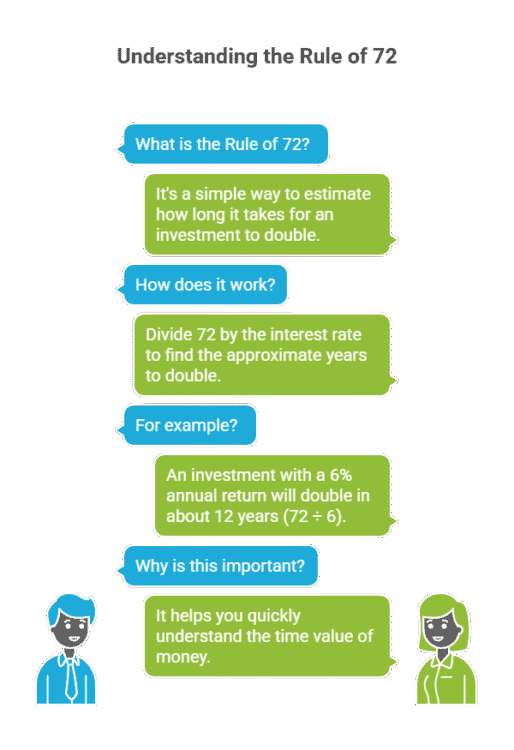
It depends on the compound rate. The Rule of 72 provides a rough estimate by dividing 72 by the annual rate. At a hypothetical 8% rate, the estimate is about nine years. It is a shortcut, not a guarantee of investment performance.
Does market volatility stop compounding?
Not necessarily, but volatility changes the growth path. Market investments compound through a sequence of gains and losses rather than a fixed positive rate. Large losses reduce the base available for the next period’s return.
Is exponential investment growth guaranteed?
No. A calculator can show exponential growth under a chosen constant return assumption. Actual investment returns vary, fees and taxes reduce results, and losses can occur. Treat projections as illustrations rather than promises.
What matters most for compounding?
The main mathematical drivers are the starting balance, return or interest rate, time, contribution pattern, withdrawals, and whether earnings remain invested. In real investing, fees, taxes, risk, and return variability also affect the outcome.
Bottom Line
Exponential growth explains why compounding can feel unimpressive early and powerful later. The percentage does not have to get larger. The base gets larger, so the same percentage can create more dollars of growth.
For planning, focus on what the curve is actually teaching you. Give compounding time. Keep adding when your plan calls for it. Understand your costs. Reinvest when appropriate. And never mistake a smooth calculator projection for a guaranteed market path.
How I Verified This Guide
I checked current investor-education guidance, the underlying compounding math, search intent, and the preserved calculator role before rebuilding this guide.
