
You get a text that looks like it came from your bank:
“Suspicious charge detected. Verify now.”
Your first job is not to decide whether the message looks real.
Don’t click the link. Don’t call the number in the message. Open your card issuer’s official app, type the bank’s website yourself, or call the number on the back of your card.
That one habit defeats a surprising number of credit card scams because it forces the story out of the scammer’s channel and into one you control.
The stakes aren’t small. The Federal Trade Commission received about 3 million fraud reports in 2025, with consumers reporting $15.9 billion in losses. Imposter scams were the most frequently reported fraud category, generating more than 1 million reports and over $3.5 billion in reported losses. Some of the costliest impersonation scams begin with fake security alerts, often supposedly from banks.
The technology keeps changing. The psychological playbook doesn’t.
Fear. Urgency. Authority. Familiarity. Hope.
For more than 25 years working with people and their money, that’s the part I’ve learned not to underestimate. Smart people don’t fall for scams because they’re stupid. A good scam is engineered to create one bad decision at exactly the wrong moment.
Quick Answer
If an unexpected bank alert, text, email, or call asks you to click, call, move money, share a verification code, or “secure” your account, stop. Contact the bank through a channel you already trust. If fraud has already happened, the right recovery steps depend on what the scammer obtained: only your card number, your account credentials, or enough personal information to steal your identity.
On This Page
- Key Takeaways Ahead
- First, Know What Credit Card Fraud Can Cost You
- Why Credit Card Scams Work: They Target Your Decisions
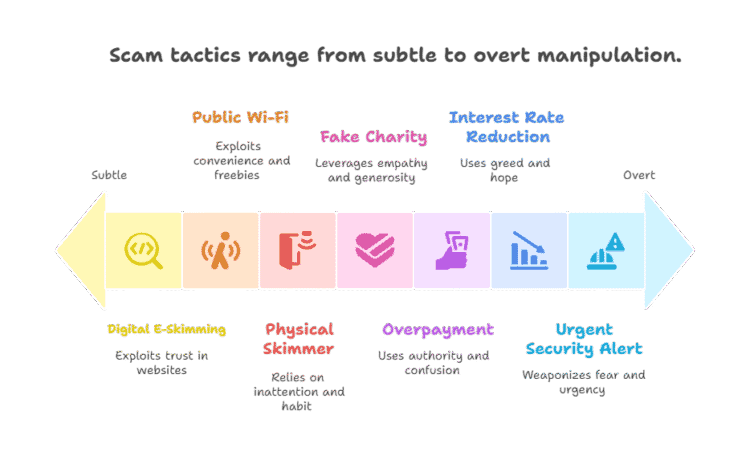
- Scam #1: The “Urgent Security Alert” Imposter
- Scam #2: The Fake Refund or Overpayment Con
- Scam #3: The Physical Skimmer or Shimmer
- Scam #4: The Fake Online Store or Checkout Page
- Scam #5: The Fake Charity or Donation Scam
- Scam #6: The “Interest Rate Reduction” Call
- Scam #7: Digital E-Skimming on a Legitimate Website
- What About Public Wi-Fi?
- What to Do After Credit Card Fraud
- 5 Habits That Make Credit Card Scams Harder to Pull Off
- The Bottom Line
- Sources
Key Takeaways Ahead
First, Know What Credit Card Fraud Can Cost You
Here’s the good news: credit cards have meaningful federal protections against unauthorized charges.
If you report a physical credit card lost or stolen before anyone uses it, the Consumer Financial Protection Bureau says you cannot be held responsible for unauthorized charges. If unauthorized use occurs before you report a missing physical card, your federal liability is generally limited to $50.
And there’s an important distinction many people miss: if a thief steals only your account number and you still have the physical card, you generally have no liability for unauthorized use.
Many issuers and card networks provide additional zero-liability protections, although their exact terms can vary.
That doesn’t mean you should wait.
Reporting quickly can stop additional transactions, get compromised card credentials replaced, preserve evidence and start the issuer’s dispute process.
Michael Ryan Money Tip
Don’t turn “I’m probably protected” into “I can deal with this later.” Fraud can keep coming after the first small charge. When something looks wrong, use the official issuer app or the number on the back of the card and deal with it while the evidence is fresh.
Why Credit Card Scams Work: They Target Your Decisions
Scammers don’t necessarily have to defeat your bank’s security.
Sometimes they just have to convince you to defeat it for them.
Their favorite levers are remarkably consistent:
- Fear: “Your account has been compromised.”
- Urgency: “You have 15 minutes to stop this transfer.”
- Authority: “I’m calling from your bank’s fraud department.”
- Familiarity: The caller ID, logo, last four digits or account detail looks correct.
- Hope: “We can cut your credit card rate in half.”
- Empathy: “Families affected by this disaster need help immediately.”
This is where I want you to change the question you ask yourself.
Don’t ask:
“Can I prove this is a scam?”
Ask:
“Can I independently prove this contact is legitimate?”
Hang up. Leave the text. Close the email.
Then start a completely new contact through the company’s real app, website or a phone number you already trust.
That tiny change matters because scammers can spoof caller ID, copy logos, know personal details and sometimes arrive at precisely the moment when a real problem has already put you on edge.
They can fake evidence.
They have a much harder time controlling a conversation you initiate independently.
Scam #1: The “Urgent Security Alert” Imposter
This is the scam I worry about most because legitimate banks really do send fraud alerts.
That makes “it looks like something my bank would send” a terrible safety test.
How it works
A text, email or call claims there’s a suspicious credit card charge, a locked account, a pending transfer, a fraud investigation, or some other financial emergency.
The scammer may spoof a real bank number or know details about you.
Then comes the important part.
They ask you to click a link, provide a password, read back a one-time verification code, move money somewhere “safe,” or install software.
Why it works
Fear + urgency + borrowed authority.
The FTC says some of the costliest impersonation scams begin with fake bank security alerts. In 2025, consumers reported about $3.5 billion in losses to imposter scams overall.
Your defense
Do not continue inside the incoming communication.
Hang up.
Open your bank’s official app or call the number on the back of your card.
Never give an unexpected caller a one-time verification code or remote access to your device.
Key Takeaway
Banks can send legitimate fraud alerts. That’s exactly why “Does this look real?” is the wrong test. Treat an unexpected alert as a reason to check your account independently—not as a trusted path into your account.
That’s also why I don’t love telling people to memorize an endless catalog of red flags.
A scammer only needs to invent the eighth scam.
Your defense should work even when you’ve never seen the script before.
Scam #2: The Fake Refund or Overpayment Con
This one weaponizes something good: your desire to correct a mistake.
How it works
Someone tells you they accidentally overpaid you, they sent too much money, a refund is waiting, or they need additional payment information to return money to you.
You may be asked to send the “extra” money back through Zelle, Cash App, Venmo, a gift card, wire transfer or another method.
The problem?
The original payment may eventually be reversed as fraudulent while the money you sent was real.
Why it works
Honesty + confusion + urgency.
You think you’re returning money that isn’t yours.
Your defense
Don’t send a separate repayment because a stranger tells you to.
If a legitimate merchant owes you a refund, work through the merchant and the original payment method.
And if the situation involves Zelle, Cash App or Venmo, recognize that you’ve crossed into a different payment system with different protections.
MRM’s guide to Zelle, Cash App and Venmo payment scams covers that problem separately.
Scam #3: The Physical Skimmer or Shimmer
Skimming isn’t new.
The hardware has simply become harder to notice.
How it works
Criminals install devices on—or sometimes inside—ATMs, fuel pumps and payment terminals to capture card information.
Some setups also capture your PIN.
The FBI warns that internal fuel-pump skimmers may be invisible to customers, which is why the old advice to simply “wiggle the card reader” isn’t enough by itself.
Why it works
Habit.
You have inserted a card into a payment terminal hundreds of times.
Your brain has no reason to treat transaction 401 differently.
Your defense
When possible:
- use tap-to-pay or another contactless method,
- cover the keypad while entering a PIN,
- favor well-lit or indoor ATMs,
- inspect a reader for anything loose, crooked, damaged or unusual,
- and don’t use a terminal that looks altered.
The goal isn’t to become a forensic technician at every gas station.
It’s to reduce unnecessary exposure.
Scam #4: The Fake Online Store or Checkout Page
Not every stolen credit card number comes from someone hacking your bank.
Sometimes you hand it directly to a fake store.
How it works
A scammer creates a fake store, sponsored ad, social-media offer or cloned checkout page that resembles a merchant you recognize.
The website may look polished.
It may even use HTTPS.
You enter your card information and either get charged for something that never arrives or simply hand the thief usable payment credentials.
Why it works
Familiarity + bargain hunting + misplaced trust.
One important correction to old internet-safety advice:
The padlock doesn’t mean the business is legitimate.
HTTPS tells you the connection is encrypted. A scammer can encrypt a connection to a scam website too.
Your defense
For unfamiliar offers:
- don’t assume an ad was vetted because a search engine or social network displayed it,
- inspect the actual domain,
- navigate to a known merchant independently when possible,
- use a credit card instead of a debit card when practical,
- and consider a digital wallet when supported.
Scam #5: The Fake Charity or Donation Scam
Natural disasters, wars, fires and tragedies create an ugly opportunity for scammers.
How it works
A fake charity—or someone impersonating a real one—asks for money through email, text, social media, phone calls or copied donation pages.
Why it works
Empathy + urgency.
You want to help while the event is happening.
That’s exactly when you’re least inclined to stop and research.
Your defense
Find the organization independently rather than donating through an unsolicited link.
Verify the charity and its donation instructions on its actual website.
And treat demands for unusual payment methods as a serious warning. The FTC specifically warns about supposed charities demanding donations through methods such as gift cards, wires or cryptocurrency.
Generosity doesn’t require urgency.
A legitimate charity will still accept your donation after you’ve taken five minutes to verify it.
Scam #6: The “Interest Rate Reduction” Call
This scam becomes more tempting when credit card interest rates are painful.
How it works
An unexpected caller promises to slash your credit card rate or debt.
They may already know your balance, ZIP code or other information.
Then comes the fee—or the request for additional account information.
Why it works
Hope.
If you’re paying 20%+ interest, someone offering a shortcut has your attention.
Your defense
End the call.
The FTC warns that unexpected calls offering to lower credit card interest rates are likely scams, and telemarketed debt-relief companies generally cannot collect fees before they actually settle or reduce a debt.
If you want a lower interest rate, you call the issuer.
The number on the back of the card works just fine.
Scam #7: Digital E-Skimming on a Legitimate Website
This is the uncomfortable one.
You can behave reasonably and still have card information stolen.
How it works
Criminals compromise a legitimate ecommerce checkout page or a third-party script running on it.
Malicious code captures payment information as customers enter it.
Unlike a fake store, the merchant itself may be legitimate.
Why it works
Trust.
You’re using the real business.
The compromised part is somewhere underneath the experience you can see.
Your defense
This isn’t a problem you can eliminate completely as a consumer.
Instead:
- turn on transaction alerts,
- review transactions regularly,
- use digital wallets when practical,
- favor credit over debit for online purchases when appropriate,
- and report unfamiliar charges promptly.
This is an important reminder that fraud prevention isn’t about becoming perfect.
Some risks have to be detected and contained, not predicted.
What About Public Wi-Fi?
Here’s another piece of fraud advice that needed updating.
You’ve probably heard some version of:
“Never do anything financial on public Wi-Fi because hackers can see everything.”
That’s too broad today.
The FTC notes that because most websites now use encryption, using public Wi-Fi is generally much safer than it once was.
That doesn’t mean every network or website is trustworthy.
It means the real question has changed.
Look for a properly encrypted connection and make sure you’re actually visiting the site you intended to visit.
And remember the distinction from the fake-store scam:
HTTPS can protect your connection to a fraudulent website. It cannot make the fraudulent website honest.
What to Do After Credit Card Fraud
The old version of this article said:
Call the bank. Place a fraud alert. File an FTC report. In that order. No exceptions.
I’m changing that advice.
It’s too blunt.
A stolen credit card number is not the same emergency as a stolen Social Security number. Treating them identically either creates unnecessary work or, worse, misses the real threat.
The better question is:
What did the scammer actually get?
What Did the Scammer Get?
Card number or unauthorized charge only
Lock the card if your issuer offers that feature, contact the issuer through its official app or the number on the card, dispute unauthorized charges, and ask whether the card should be replaced. Keep monitoring for additional transactions.
Account password, email password or verification code
Do the card steps above, then secure the affected login. Change compromised passwords from a trusted device, sign out other sessions when possible, and enable stronger multifactor authentication. If your email account was compromised, secure it too—email can be the reset key for your other financial accounts.
Social Security number, government ID, or enough personal information to open accounts
Treat this as identity-theft risk. Freeze your credit with all three nationwide credit bureaus, review your credit reports for unfamiliar accounts or inquiries, and use IdentityTheft.gov for a recovery plan when identity theft has occurred.
That distinction matters.
A fraud alert is not automatically step two after every unauthorized credit card charge.
The FTC explains that a credit freeze restricts access to your credit file and must be placed separately with all three nationwide credit bureaus. A fraud alert tells prospective creditors to take extra steps to verify your identity; contacting one bureau can initiate the alert across all three.
If I’m worried that someone has enough information to open new accounts, I would rather see you understand the stronger protection of a credit freeze than mechanically place a fraud alert because an old checklist told you to.
For a deeper identity-theft response, see MRM’s identity theft prevention strategies.
And one more distinction:
If money was stolen through a debit card or checking account, don’t assume these credit-card liability rules apply.
Contact the bank immediately. Debit-card protections and deadlines are different.
5 Habits That Make Credit Card Scams Harder to Pull Off
You don’t need seven complicated defenses for seven scams.
You need a handful of habits that work across dozens of scams.
1. Start financial contact yourself
If a message creates urgency, leave the message.
- the official banking app,
- a bookmark you created yourself,
- a recent statement,
- or the phone number printed on your card.
This is the single habit I would teach first.
2. Use unique passwords and turn on MFA
A password manager makes unique passwords practical.
Turn on multifactor authentication for your email and financial accounts.
When a service offers stronger phishing-resistant authentication methods, they’re preferable to codes that can be tricked out of you. But don’t turn perfect into the enemy of good: MFA is still an important additional barrier.
3. Turn on transaction and login alerts
You want the time between fraud and discovery to be as short as possible.
I also like something decidedly low-tech:
a five-minute weekly transaction scan.
It isn’t glamorous.
That’s why it works.
It’s simple enough to become a habit, and it gives those tiny “test” charges fewer places to hide.
4. Reduce how often your raw card number is exposed
Use tap-to-pay and digital wallets when practical.
For online purchases, I generally prefer a credit card over a debit card when both are reasonable choices.
The practical reason isn’t just statutory liability.
If something goes wrong with a debit transaction, the disputed money may be your checking-account cash while the problem gets sorted out.
5. Know when card fraud has become identity theft
One unauthorized charge doesn’t automatically mean a criminal can open a mortgage in your name.
Don’t panic yourself into solving a problem you don’t have.
But if you see:
- an unfamiliar credit inquiry,
- a new account you didn’t open,
- a lender contacting you about an application you didn’t make,
- or evidence that sensitive identity information was stolen,
then you’ve moved beyond ordinary card replacement.
That’s when credit freezes and a broader identity-theft recovery plan become important.
The Bottom Line
The safest credit card user isn’t the person who can identify every scam on sight.
That’s an impossible standard.
Scammers change scripts. They spoof real phone numbers. They reuse stolen information. Sometimes they catch you while you’re distracted. Sometimes they contact you immediately after a real fraud event, when a supposed call from the fraud department seems perfectly logical.
So don’t build your defense around being smarter than every scammer.
Build it around one rule they can’t easily defeat:
Don’t let an incoming message control your next step.
Scammers need you to stay inside their channel.
Your job is to leave it.
If the bank alert is real, it’ll still be real when you open the official app or call the number on your card.
If it’s fake, you just broke the scam’s most important advantage:
control of the conversation.
Sources
- Federal Trade Commission — 2025 imposter scam data
- Federal Trade Commission — 2025 total fraud loss data
- Consumer Financial Protection Bureau — unauthorized credit card charges
- Federal Trade Commission — credit freezes and fraud alerts
- Federal Bureau of Investigation — skimming
- Cybersecurity and Infrastructure Security Agency — multifactor authentication
- PCI Security Standards Council — payment security
