

Do not recycle your Medicare Annual Notice of Change without reading it.
That thick Medicare envelope sitting on the counter is easy to ignore. It looks like a pile of fine print telling you that your plan changed a few dollars here and there.
Sometimes that is all it is.
Sometimes the premium barely moves while a prescription changes tiers, a specialist costs more, or a hospital you rely on is no longer in your plan’s network.
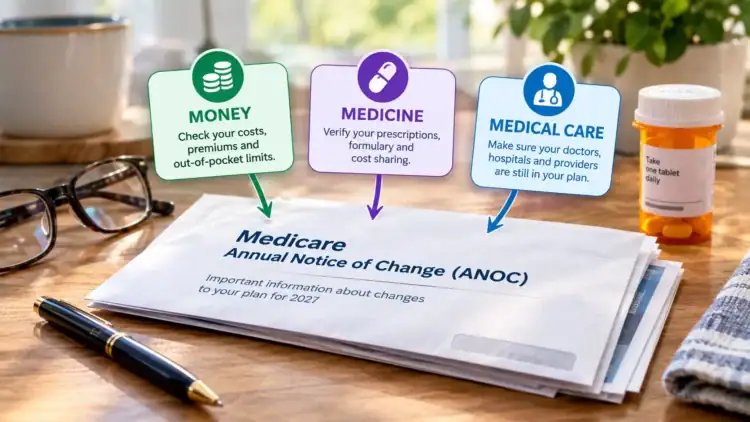
You do not need to read the whole document tonight. Start with three things: Money. Medicine. Medical care.
What will this plan actually cost you in 2027?
Check the premium, deductibles, copays, coinsurance, and Medicare Advantage out-of-pocket maximum.
Will your prescriptions still work financially?
Check the formulary, drug tier, cost sharing, restrictions, and preferred pharmacy status.
Can you still use the doctors and facilities you rely on?
Check doctors, specialists, hospitals, networks, referrals, and prior authorization rules.
Show the quick check
- Money: Compare the 2027 premium, deductibles, copays, coinsurance, and Medicare Advantage out-of-pocket maximum with 2026.
- Medicine: Check every regular prescription for coverage, tier, restrictions, and preferred pharmacy status.
- Medical care: Verify the doctors, specialists, hospitals, and facilities you rely on in your exact 2027 plan and network.
- Deadline: Medicare Open Enrollment runs October 15 through December 7.
- Decision rule: If one of the three areas changes materially, compare plans before Open Enrollment ends.
If you are in a Medicare Advantage Plan or Medicare drug plan, your plan sends an Annual Notice of Change, usually called an ANOC, each fall. It tells you about changes taking effect January 1.
Medicare says these notices arrive in September. Medicare guidance says plans send a printed ANOC by September 30. Medicare Open Enrollment runs from October 15 through December 7.
If September 30 passes and you still do not have it, contact your plan. Do not assume that no letter means no changes.
On This Page
- 1. Check what your Medicare plan will cost in 2027
- 2. Check every prescription in your Medicare ANOC
- 3. Check your doctors, hospitals, and Medicare Advantage network
- Do the five-minute Medicare ANOC check now
- What if everything in your ANOC looks fine?
- What if you never received your Medicare ANOC?
- The Medicare ANOC mistake I would avoid
- Frequently asked questions
- Official sources
- How We Verified This
1. Check what your Medicare plan will cost in 2027
Start with the boring numbers because they are easy to compare and easy to underestimate.
Look at the monthly premium, deductible, copays, coinsurance, and the plan’s maximum out-of-pocket limit if you have Medicare Advantage. Then compare them with 2026.
A premium that barely moves can still hide higher specialist copays, hospital costs, imaging costs, or other increases that matter far more to someone who actually uses the plan.
Imagine your monthly premium rises only $4. At first glance, that looks like good news.
But your specialist copay rises from $40 to $60. You see that specialist eight times a year. One regular prescription moves to a more expensive tier. Your preferred hospital is no longer in the same network position.
The $4 premium increase was never the real change.
That is why I would not judge a plan by the premium alone. In financial planning, I saw people naturally gravitate toward the easiest number on the page. The easier number was not always the one determining what the year actually cost them.
Write down these five numbers:
- 2027 monthly premium
- Medical deductible, if any
- Drug deductible, if any
- Specialist and hospital cost sharing
- Maximum out-of-pocket limit for Medicare Advantage
The useful question is not, “Did my premium go up?” It is, “What would this plan cost me if I use Medicare the way I actually use it?”
2. Check every prescription in your Medicare ANOC
This is where I would slow down.
A plan can look almost identical until one medication you rely on changes tiers, gets a new restriction, or costs more at the pharmacy you normally use.
For every prescription you take regularly, check whether it is still on the plan’s 2027 formulary. Then check its tier, copay or coinsurance, pharmacy requirements, prior authorization, step therapy, and whether your preferred pharmacy still receives preferred pricing.
Do not stop after seeing the drug’s name on the formulary. Covered does not necessarily mean covered the same way.
- Is it still covered?
- Did the tier change?
- Did the copay or coinsurance change?
- Is prior authorization new?
- Is step therapy new?
- Is your pharmacy still preferred?
What does the $2,400 Medicare Part D number mean in 2027?
For 2027, the Medicare Part D annual out-of-pocket threshold is $2,400 for covered Part D drugs.
Think of it as a marker on the year’s Part D spending path, not a promise that every prescription will cost less.
- You fill covered Part D prescriptions during the year.
- Amounts that qualify toward your True Out-of-Pocket, or TrOOP, costs accumulate.
- When those eligible costs reach the $2,400 threshold, you enter the catastrophic phase.
- In that phase, you generally owe no additional cost sharing for covered Part D drugs for the remainder of the year.
But the $2,400 threshold does not guarantee that a particular medication is covered, stays on the same tier, or keeps the same plan rules.
If one medication that matters to you changes significantly, that alone can be enough reason to compare plans during Open Enrollment.
3. Check your doctors, hospitals, and Medicare Advantage network
If you have Medicare Advantage, do not stop at the premium and drug list.
Check the providers and facilities you actually rely on. That may include your primary care doctor, specialists, hospital system, rehabilitation facility, therapy provider, home health provider, or another recurring source of care.
Also look for changes to referrals, prior authorization, service areas, benefits, and other plan rules that affect access.
If you have Medicare Advantage, the more useful question is whether the doctor, hospital, or facility participates in your exact plan and network for 2027.
- Your primary care doctor
- Specialists you see regularly
- Your preferred hospital system
- Therapy or rehabilitation providers
- Home health or other recurring care
- Any new referral or prior authorization requirements
Provider networks can change during the year too. The ANOC is the place to start, not necessarily the place to stop.
For a doctor, hospital, or facility you consider essential, confirm participation with both the plan and the provider before making an enrollment decision.
Do the five-minute Medicare ANOC check now
You are not trying to become a Medicare expert. You are trying to find the changes capable of affecting your wallet, your prescriptions, or your access to care.
Check each item only after you actually verify it.
You are trying to answer three questions: Will this cost me more? Will my prescriptions still work? Can I still get care where I want it?
What if everything in your ANOC looks fine?
That can be good news. It does not automatically mean you need to switch plans just because Open Enrollment exists.
But make sure “looks fine” means you checked the things that matter to you, not just the monthly premium on the first page.
If your costs remain acceptable, your prescriptions still work under the plan, and the providers you depend on remain available under terms you are comfortable with, you have answered the three questions this review was designed to answer.
What if you never received your Medicare ANOC?
Contact your plan. Medicare specifically tells beneficiaries to contact the plan if this notice does not arrive.
You can also use Medicare’s Plan Compare tools when 2027 plan information is available for Open Enrollment.
The Medicare ANOC mistake I would avoid
After nearly three decades around financial planning, this is exactly the sort of paperwork I saw people put aside because nothing felt urgent yet.
That is what makes the ANOC easy to ignore. The consequence is usually sitting several months away.
Then January arrives and the change is no longer theoretical.
The ANOC is not junk mail. It is your plan telling you, in advance, what it intends to change.
You do not need to memorize it.
Check what you will pay. Check every prescription that matters. Check the doctors and facilities you depend on.
The obvious change is not always the real change.
Frequently asked questions
When should I receive my Medicare ANOC?
Medicare says the Annual Notice of Change arrives in September. Medicare guidance says plans send a printed ANOC by September 30. If you do not receive it, contact your plan.
When is Medicare Open Enrollment for 2027 coverage?
Medicare Open Enrollment runs from October 15 through December 7. Changes made during this period generally take effect January 1, provided the plan receives the enrollment request by December 7.
What is the Medicare Part D out-of-pocket threshold for 2027?
The Medicare Part D annual out-of-pocket threshold is $2,400 for 2027. When TrOOP-eligible costs reach the threshold, the beneficiary enters the catastrophic phase and generally owes no additional cost sharing for covered Part D drugs for the rest of the year.
Does the $2,400 threshold mean all of my prescriptions are covered?
No. The threshold is a Part D cost-protection feature. It does not require every plan to cover every drug or keep a drug on the same tier with the same utilization rules. That is one reason to check the formulary and plan rules in your ANOC.
Does my ANOC show every provider that could leave my network?
The ANOC can alert you to plan and coverage changes, but provider networks can also change during the year. If continued access to a particular doctor, hospital, or facility is important to you, verify participation directly before making an enrollment decision.
Official sources
- Medicare.gov: Plan Annual Notice of Change
- Medicare.gov: Open Enrollment
- CMS: 2027 Medicare Advantage and Part D Rate Announcement
- CMS: Contract Year 2027 Medicare Advantage and Part D Final Rule
How We Verified This
These are the authorities and references used to verify the material facts in this article.
