
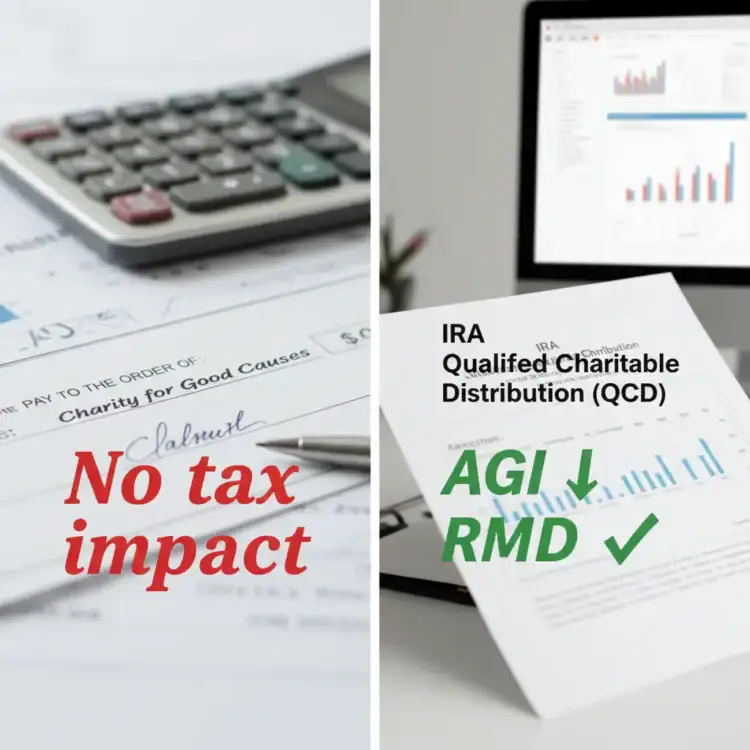
A Qualified Charitable Distribution can still be more powerful than writing a check to charity in 2026, but the reason changed. Starting in 2026, non-itemizers can deduct up to $1,000 of qualifying cash gifts, or $2,000 on a joint return. So the old blanket advice that a cash donation gives a non-itemizer “no tax benefit” is no longer accurate.
The bigger distinction is where the tax benefit happens. A cash charitable deduction reduces taxable income after adjusted gross income is calculated. A properly executed Qualified Charitable Distribution, or QCD, excludes eligible IRA dollars from income in the first place. That can reduce AGI and the modified adjusted gross income used for Medicare IRMAA.
That difference matters most when you are age 70½ or older, already give to charity, and have money in an IRA that would otherwise become taxable income. It can matter even more once required minimum distributions enter the picture.
Show the quick version
- Cash gifts changed in 2026: Non-itemizers may deduct up to $1,000 of qualifying cash gifts, or $2,000 on a joint return. That deduction reduces taxable income, but not AGI.
- A QCD works differently: An eligible QCD goes directly from the IRA to a qualified charity and can be excluded from taxable IRA income.
- That is why IRMAA cares: IRMAA uses MAGI that starts with AGI. A QCD can lower that number; an ordinary charitable deduction generally does not.
- 2026 QCD limit: The 2026 annual QCD exclusion limit is $111,000 per eligible IRA owner. Each spouse has a separate limit if each qualifies and uses their own IRA.
- Watch the clock: A QCD made in 2026 generally affects Medicare IRMAA two years later, not your 2026 premium. 2026 Medicare premiums generally use 2024 MAGI.
On This Page
- What Changed for Charitable Giving in 2026?
- Why a QCD Can Lower IRMAA When a Cash Donation Does Not
- QCD vs. Cash Donation in 2026: What Actually Changes?
- Qualified Charitable Distribution Rules for 2026
- QCD and RMD Timing: Do Not Wait Until After You Took the Full RMD
- How Much Can the IRMAA Difference Matter?
- When a QCD May Not Be Your Best Charitable-Giving Move
- How a QCD Is Reported on Your Tax Return
- Qualified Charitable Distribution FAQ
- Bottom Line: In 2026, the QCD Advantage Is About AGI, Not Just the Deduction
- How We Verified This
What Changed for Charitable Giving in 2026?
There are two 2026 changes that make the old “QCD versus standard deduction” explanation more nuanced.
- Non-itemizers can now deduct some cash giving. The IRS says taxpayers who take the standard deduction may deduct up to $1,000 of qualifying cash contributions, or $2,000 if married filing jointly.
- Itemized charitable deductions have a new floor. Beginning in 2026, an itemizer generally deducts charitable contributions only to the extent they exceed 0.5% of AGI.
The basic 2026 standard deduction is $32,200 for married couples filing jointly, $16,100 for single filers and married people filing separately, and $24,150 for heads of household. Eligible taxpayers age 65 or older may also qualify for the separate enhanced senior deduction of up to $6,000 per person, subject to its income phaseout.
2026 Correction That Matters
A cash gift is no longer automatically “tax-irrelevant” just because you take the standard deduction. But the new $1,000/$2,000 non-itemizer charitable deduction still does not reduce AGI. That is why it does not replace the QCD for IRMAA planning.
Why a QCD Can Lower IRMAA When a Cash Donation Does Not
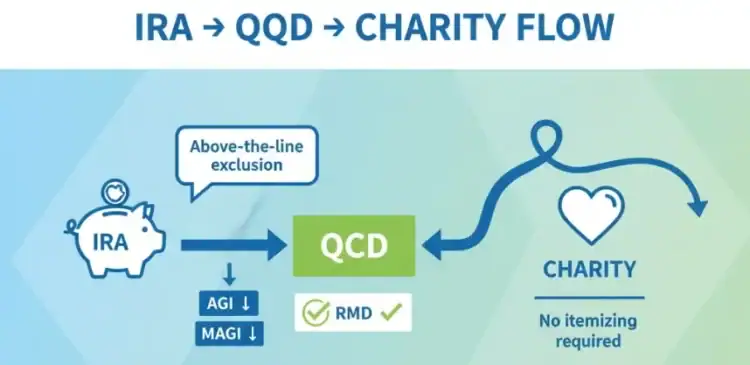
IRMAA does not look at your taxable income after the standard deduction. Social Security generally starts with the adjusted gross income on your tax return and adds tax-exempt interest to determine the MAGI used for Medicare’s income-related surcharge.
That is why two charitable gifts of the same size can have different Medicare consequences. A cash deduction can reduce taxable income. A QCD can prevent eligible IRA income from entering AGI in the first place.
Follow the money, then follow the tax return
Why the QCD can reach IRMAA when a cash deduction cannot
The important difference is not whether both gifts can create a tax benefit. It is where that benefit appears in the calculation.
- 1You already plan to give
The charitable goal stays the same. The question is whether the gift comes from your bank account or directly from an eligible IRA.
- 2Cash gift becomes a deduction
In 2026 a non-itemizer may get up to a $1,000/$2,000 deduction. An itemizer may also qualify under the Schedule A rules.
- 3But AGI is already set
Those deductions reduce taxable income after AGI. They generally do not lower the MAGI used for IRMAA.
- 4A QCD can bypass that income
An eligible direct IRA-to-charity distribution can be excluded from taxable IRA income, lowering AGI and potentially future IRMAA MAGI.
The two-year IRMAA clock is the part people miss
Medicare generally uses tax information from two years earlier. For example, 2026 Medicare premiums generally use 2024 MAGI. A QCD you make during 2026 normally affects the tax return used for 2028 IRMAA, not the premium you are paying in 2026.
Do Not Plan With the Wrong IRMAA Year
If you already received a 2026 IRMAA notice, making a QCD now does not rewrite your 2024 tax return. A 2026 QCD can help manage 2026 MAGI and therefore a later Medicare premium year. If your income fell because of a qualifying life-changing event, an SSA-44 appeal is a different tool.
If the Medicare timing is your main concern, use my current guide to how to avoid IRMAA. It separates moves that change current MAGI from moves that address an IRMAA notice you already received.
QCD vs. Cash Donation in 2026: What Actually Changes?
| Question | QCD | Cash gift |
|---|---|---|
| Can it create a federal tax benefit without itemizing? | Yes, if the QCD rules are met. The eligible distribution is excluded from income. | Yes, beginning in 2026, but the non-itemizer deduction is capped at $1,000, or $2,000 on a joint return. |
| Can it reduce AGI? | Yes. Eligible IRA income is excluded before AGI is determined. | Generally no. The charitable deduction is applied after AGI. |
| Can it reduce IRMAA MAGI? | Potentially yes, because lower AGI generally lowers the starting point for IRMAA MAGI. | Generally no, even when the gift produces a charitable deduction. |
| Can it satisfy an RMD? | Yes, all or part of an eligible QCD can count toward the year’s IRA RMD. | No. Taking an RMD into your bank account first generally creates taxable IRA income. |
| Can it go to a donor-advised fund? | No. QCDs generally cannot be made to donor-advised fund sponsors, private foundations, or supporting organizations. | A contribution to a qualifying donor-advised fund may be possible under the separate charitable-deduction rules. |
Michael’s Take
I would not frame this as “QCD good, cash bad.” Start with the charitable goal, then ask what asset should fund it. If the money would otherwise come out of a traditional IRA and become taxable income, a QCD can solve a different problem than a check from your bank account.
Qualified Charitable Distribution Rules for 2026
For 2026, the annual QCD exclusion limit is $111,000 per eligible IRA owner. A married couple does not get a shared $222,000 QCD from one spouse’s IRA. Each spouse must independently qualify and make the distribution from that spouse’s own IRA.
- You must be at least age 70½ on the date of the distribution. The QCD age did not rise when the RMD starting age rose.
- The money generally must go directly from the IRA trustee to an eligible charity. Taking the IRA withdrawal yourself and then writing a personal check is not the same transaction.
- Traditional IRAs are the most common source. Ongoing SEP and SIMPLE IRAs have restrictions. A 401(k) distribution itself is not a QCD.
- You cannot double-dip. The amount excluded from income as a QCD is not also claimed as a charitable contribution deduction.
- You still need the charity acknowledgment. Keep the same type of written substantiation you would need for a charitable contribution.
- Not every charity qualifies for a QCD. Donor-advised fund sponsors, private foundations, and supporting organizations generally cannot receive QCDs.
One Small 2026 Reporting Change
The IRS added optional code Y to Form 1099-R reporting for QCDs in 2026. Because using the code is optional for 2026, do not assume your tax software will automatically know the full distribution was a QCD. Review the IRA-distribution and taxable-amount entries carefully.
For the broader mechanics, eligible IRA types, charity restrictions, and edge cases, see my dedicated guide to how Qualified Charitable Distributions work. This page is intentionally focused on the 2026 QCD-versus-cash decision and the MAGI/IRMAA consequence.
QCD and RMD Timing: Do Not Wait Until After You Took the Full RMD
A QCD can count toward all or part of your required minimum distribution. That is one of its biggest practical advantages. But sequencing matters.
Suppose your RMD is $30,000 and you already planned to give $8,000 to charity. If the $8,000 QCD is completed before you have satisfied the full RMD with other distributions, it can count toward that $30,000 requirement. You would then need another $22,000 of qualifying distributions to finish the RMD.
If you instead take the full $30,000 into your bank account first, that taxable distribution has already satisfied the RMD. An $8,000 QCD later in the year can still be a valid QCD if the rules are met, but it does not retroactively make the earlier $8,000 of cash withdrawal disappear from income.
Practical Move
If you know you want to use charitable giving to satisfy part of an RMD, coordinate the QCD before you automatically sweep the full RMD into checking. This is one of those planning mistakes that is much easier to prevent than repair.
If you are still deciding what to do with an RMD you do not need, see the five tax-smart choices for an unneeded RMD and use the 2026 RMD calculator for the required amount itself.
How Much Can the IRMAA Difference Matter?
The answer depends on where your MAGI lands relative to the Medicare thresholds for the premium year in question. A QCD does not create an IRMAA savings just because you made one. It helps only when lowering MAGI changes the surcharge tier or keeps you farther from a threshold you otherwise would cross.
As a reference point, the first 2026 IRMAA tier begins above $109,000 for an individual and above $218,000 for married couples filing jointly. At that tier, the 2026 Part B surcharge is $81.20 per month per person and the Part D IRMAA is another $14.50 per month, in addition to the person’s drug-plan premium.
Hypothetical Planning Example
A married couple already intends to give $5,000 to a qualified charity and is eligible to use a QCD. If $5,000 of taxable IRA income would otherwise push the MAGI used for a future Medicare year across an IRMAA threshold, directing that $5,000 from the IRA to charity as a QCD could keep it out of AGI. Writing a $5,000 personal check may still produce a federal charitable deduction in 2026, but that deduction generally does not lower the AGI-based MAGI used for IRMAA.
The future threshold still matters. A QCD in 2026 generally affects 2028 IRMAA, and the 2028 brackets are not the same thing as the published 2026 brackets. Do not use today’s Medicare threshold as a guaranteed future target.
When a QCD May Not Be Your Best Charitable-Giving Move
A QCD is powerful, but it is not automatically the best asset to give every year.
- You are younger than 70½. You cannot make a QCD yet.
- You want to fund a donor-advised fund. A QCD generally cannot go to a DAF sponsor.
- You own highly appreciated taxable investments. Donating appreciated securities may eliminate capital-gains tax while also producing a charitable deduction when the rules are met.
- You need the IRA money for spending. Do not give away retirement cash merely to chase a tax result.
- You are nowhere near an IRMAA threshold. The MAGI benefit can still matter for income taxes and other AGI-based items, but there may be no Medicare-premium savings.
How a QCD Is Reported on Your Tax Return
Your IRA custodian reports the distribution on Form 1099-R. On the federal return, you generally report the full IRA distribution amount and then report only the taxable portion as taxable income. When the full eligible amount is a QCD, the taxable amount can be zero and the return identifies the QCD according to the Form 1040 instructions.
Keep the charity’s written acknowledgment and your IRA records. If your IRA contains after-tax basis, if you make other IRA distributions in the same year, or if you are dealing with an inherited IRA, Roth IRA, SEP IRA, or SIMPLE IRA, the reporting can become more complicated.
Qualified Charitable Distribution FAQ
What is the QCD limit for 2026?
The 2026 annual QCD exclusion limit is $111,000 per eligible IRA owner. A spouse who independently qualifies and uses that spouse’s own IRA has a separate individual limit.
Can a QCD be larger than my RMD?
Yes. An eligible QCD can exceed the amount needed to satisfy the current year’s RMD, up to the applicable QCD limit. The extra amount does not count toward a future year’s RMD.
Can I claim a charitable deduction for a QCD?
Not for the amount that is excluded from income as a QCD. That would give you two federal tax benefits for the same dollars.
Does a QCD reduce Social Security taxation too?
Potentially. Because an eligible QCD can keep taxable IRA income out of AGI, it can also affect calculations that depend on income, including the amount of Social Security benefits that becomes taxable. The result depends on the rest of your tax return.
Does a QCD made in 2026 lower my 2026 IRMAA?
Generally no. 2026 Medicare premiums are generally based on 2024 MAGI. A QCD made during 2026 normally affects the MAGI on your 2026 tax return, which is generally used for Medicare premiums two years later.
Do I have to wait until RMD age to make a QCD?
No. The QCD eligibility age remains 70½. That creates a planning window before RMDs begin for many IRA owners.
Bottom Line: In 2026, the QCD Advantage Is About AGI, Not Just the Deduction
The 2026 law change makes the comparison more honest. A non-itemizer’s cash gift can now create a limited federal charitable deduction. That is useful.
But a QCD still does a different job. If you are eligible, charitably inclined, and would otherwise take taxable money from an IRA, the QCD can keep those dollars out of AGI, count toward an RMD, and potentially lower the MAGI used for future IRMAA. That is why I would compare the income path, not just ask which option gives you a deduction.
How We Verified This
- IRS Topic No. 506: Charitable Contributions. 2026 non-itemizer cash-contribution deduction.
- IRS Publication 505 (2026). 2026 standard deduction, charitable-deduction treatment, and the 0.5% AGI floor for itemized charitable contributions.
- IRS Publication 590-B. QCD eligibility, direct-transfer rule, RMD treatment, and annual exclusion mechanics.
- IRS 2026 Form 1099-R Instructions. Optional QCD reporting code Y for tax year 2026.
- Social Security Administration: IRMAA MAGI Rules. AGI plus tax-exempt interest and the general two-year lookback.
- CMS: 2026 Medicare Part B and Part D IRMAA. Current 2026 thresholds and surcharge amounts.
